Sunday, October 04, 2009

My mother

My mother was staying with me for the last six months and today she left to India with my brother. Father and Mother are not part of the family in Japan. Each country has its own rules and regulation for immigration. But Japanese government is kind enough to give permission on some exceptional cases for mother to stay with her son if that son is the only one male offspring.

My mother’s temporary visa which was for 90 days could extend once more for another 90 days. So, she could stay in Japan for 180 days. I like to share my own experience of bringing mother to Japan as I think it may help some people who wish to bring their family members here.

At first I applied for certificate of eligibility for my mother too along with wife and kids. Mother’s application was returned on grounds of immigration limitations and I proceeded for temporary visitor visa application at Chennai consulate. The process and documents required to get visitor visa to Japan are very easy and on the third working day, we will get the visa stamped on the passport.

The documents I did send from here to stamp the temporary visa were the following; Application form, Letter of Guarantee, Schedule of Stay, Income tax certificate, Photocopy of my passport (the page of passport where mother’s name is written is important to prove the relationship) and Alien registration card. If the application for the visa is processed through an agent, it is necessary to give authorization letter in white paper. Before proceeding for a temporary visa, even though consulted with experienced friends, it is advisable and necessary to check the MOFA website for the updated information and application form.

Mother was under treatment also, while she was in Japan. There was no insurance coverage for the treatment since she had visitor status. The doctors in Tokyo treated her as if she is a resident of Japan. The hospital staff also co-operated throughout the treatment in the clinic at Higashi Ojima. Since she was undergoing physiotherapy treatment, she had to attend the clinic regularly.


On holidays we used to go for outing to the nearby places. The life is meaningful and the time is worth if spent with the dear and near ones. The bits of pleasures and joyous moments after sharing become more enjoyable life experiences. So were the gone days for me too.

Mother forms our world in our childhood and she transforms our life with her presence. In Indian culture, mother is more than God and assumes various roles in the family relations. She is the uniting force among the offspring in a joint family.


The presence of mother gives a sense of security to us in our childhood. We feel it more when we are sick. That sense of security is unique and none of the robotic technology could be an alternative. While writing this, I have been thinking about those who could not feel the presence of their mother. Unfortunately there is a significant section of our society with such people.

Contrary to the negative remarks appearing in many websites against the Japanese attitude towards foreigners, we could not notice even one such negative experience at the hospital or the public places we visited during the last 180 days. It prompts me think that the anti- Japanese propaganda may not be really true. It may be from some groups with vested interest. The Japanese doctor who was treating her asked for a group photo on the day when we told her that mother will go back on 4th October.

Coming back from Narita Airport, my mind was void at times. With the feeling of swinging between the unreal world and the real world outside, I entered to the Keisei train boarded for Ueno. Those who could not feel the presence of human mother have the feeling of imaginary mother and often we call it mother-nature. Whatever be the feeling, mother is the big part of our real world!

Thursday, October 01, 2009

What are the places to see in Tokyo? – places to visit in and around Tokyo

Tokyo is an incredible place to visit! This is what I read in many sites when I searched for ‘Places to see in Tokyo’ in google and Yahoo. It is almost 10 days since my brother landed in Japan. We visited around 15 places in and around Tokyo. The visiting schedule is hectic and he has 3 more days in Japan.

I asked some of my friends for their recommendations. Most of them suggested places like Tokyo Tower, Yokohama China Town, Kamakura, Asakusa Sensoji temple, Ginza, Harajuku Meiji Jingu Shinto shrine, Shinjuku, Shibuya, Mount Fuji, Five lakes, Hakone, Akihabara Electric city, Odaiba, Ueno Gardens and Zoological park etc. We could complete our schedules one by one except the Mount Fuji Trip. There is no point in travelling all the way to Mount Fuji only to view the mountain. Mount Fuji is open for climbing on July and August.


A first time visitor will definitely get excited by seeing Tokyo and its surroundings. The technological development Japan could achieve is amazing and significant. A short time visitor will be interested to watch the Japanese discipline and obedience to the law. The pin-drop silence at many of the crowded railway stations is another noticeable thing in Japan that a first time visitor will get astonished. Japanese people are silent due to the disciplined nature at public places like railway stations and bus-stops. They are even silent inside the train also. Most of the times we later realize people talking inside train and public places are foreigners!

Visiting Japan itself is an experience for foreigners! Probably we can not see a place like this at any other part of the world except here! Let me confirm once more that Japanese people are unique! We have many things to learn from Japan. The places we visited are not many, but everywhere we could observe some of the common things like discipline, silence, Obedience, Politeness, Smiling faces etc.


Today, we are planning to go to Imperial Palace. Tokyo Imperial palace is a great place to visit in Tokyo and it is the residence of Japan royal family. Imperial palace was built during the 250 years long Tokugawa Shoguns rule at the center of Tokyo as a fortress for protection. East Gardens of the Imperial palace is open to public daily except on Mondays, Fridays and on national holidays and this is the only par to the palace that is open for visit. For a visit to the imperial palace, we need to book in advance. If you plan your visit to Imperial palace click on this link and book in advance. Imperial Household Agency Homepage


Now, I can suggest some of the places to visit in Tokyo during your short trip next time.


1. Tokyo Tower
2. Mount Fuji
3. Hakone – Gora – Sounzan – Togendai – Ashi Lake trip
4. Odaiba
5. Kamakura
6. Ueno
7. Shinjuku
8. Shibuya for shopping
9. Akihabara Electric city
10. Yokohama China Town
11. Tokyo Disneyland and Disney Sea
12. Asakusa Sensoji Temple
13. Harajuku
14. Tokyo Imperial Palace
15. Ginza


The list goes without ending here with just 15 places, but I have just listed some of the major attractions in and around Tokyo, which we have visited with the advices of our friends. Just do searches in google or yahoo. They will give you more insights about the places to visit in Tokyo. However, I think, the above places in Tokyo cover a good trip to Tokyo.

Tokyo is a unique and wonderful tourist destination. Tokyo is not only to be read, but also a place to be experienced by walking and riding throughout the length and breadth. It is curious to learn how the ancient Japanese culture transforms slowly to modern technological advancements.

Tuesday, September 22, 2009

Vibrant Harajuku and Meiji Jingu Shinto shrine in Tokyo

It was a huge crowd outside Harajuku station when we came out. The crowd was moving slowly but gently. The purpose of the visit was uncertain when we started from Higashi Ojima. I did a google search for ‘Places to see in Tokyo’. Some of the search results guided me to see Fuji mountain, Kamakura, Tokyo Tower, Shinjuku, Odaiba, Ueno Park and zoo, Ginza, Yokohama China town etc.

Even by repeating the searches in Yahoo and other search engines I got the same places in the search results. I was eager to get something different from general search engine recommendations. The same thing happened for the first few pages of search resuslts, when I changed the search keywords to ‘Must see places in Tokyo’, but this time I got a place ‘Harajuku’ in the list recommended by an American tourist who had visited this place on his trip to Tokyo.

That was the motivation to visit Harajuku today. We could see live animation characters outside the station, lesbians and some groups of gays. I am not sure whether this is the normal view of Harajuku station. There were groups of young Japanese girls and boys sitting on the nearby stone benches which seemed to me as a mere casual meeting.

I have been taking my brother to different places in Tokyo now a days on his short trip to Tokyo. We walked to the direction of the crowd. It helps many times in life when we move with the trend. There will be always something towards which the crowd goes. The psychology of the mass or crowd is also motivated by the determination of those who move on the front. When we turned left, right after the Harajuku Yamanote line station, we could see a forest, virtually more beautiful than the real forest and a historical style entrance.


Before entering, we could collect leaflets that described about the place and its importance. To our surprise, it was ‘Meiji Jingu’ which is a Shinto shrine. Shinto is Japan’s religion, which has no founder, no holy book and no concepts of traditional religions. Shinto is a way of Japanese living with high values respecting the nature and living things. The Shinto shrine which we visited accidently is dedicated to the souls of Japanese emperor ‘Meiji’ and his consort empress ‘Shoken’. It was interesting to know that their tomb is in Kyoto.

This forest was made by Japanese people by donating trees from different parts of Japan and from all over the world. It is now the history that there are 100,000 tress total in the forest and it was established on November 1920. The artificial forest in the middle of concrete forest looked more than the natural forest.

We could see a collection of rice wine barrels on the side of the path towards the shrine. The visitors were eager to take snaps of the traditional Japanese customs and architectures around the main shrine. In Shinto religion, divinity or diving spirit is known as ‘Kami’. Unlike Christian religion which talks about one spirit, Shinto religions has no limit in the number of divine spirits or Kami. There are unlimited number of kami. Kami can be observed in Nature, mythology or in human beings. It is said that from times unknown Japanese people have felt awe and gratitude towards such Kami (divine spirit) and have built shrines to such Kami.

This kind of belief is similar to the believes in Hindu religion, the most widely practiced religion in India. In fact in India, these divine spirits became Gods over a period of time and they also got one or several shrines according to their popularity.


We could see Japanese traditional style marriage being held inside the shrine premise. Many visitors were taking photographs of the ceremonies. Meiji Jingu Gardens or Gyoen was the part of Meiji Jingu Shrine that has been existing long before building the Meiji Jingu. Emperor Meiji designed this iris garden, small paths and fishing spot for Empress Shoken.


“Although we may feel Overworked and burdened,
Our human hearts should go on remaining filled with an open calmness” is the Waka poetry written by Empress Shoken. The wisdom of Emperor Meiji and Empress Shoken were handed over to the generations next through these Waka poems. Visitors can draw a poem from 30 selected poems from the ‘Omikuji’ box, which exists in front of the main shrine.

Now not exaggerated to say, our visit to Harajuku was really worth. It took us to a different world in the middle of modern Tokyo. I can strongly recommend now to visit Meiji Jingu and Harajuku for those who plan a short visit to Tokyo along with their visit to Shinjuku. It is just two stations away from Shinjuku station on the JR Yamnote line. Harjuku is also a place for fashion and we can see many live animated models walking on the road! Have a nice trip to Harajuku!

Monday, September 14, 2009

Onam festival celebrations in Japan

Onam, the festival of flowers and colors being celebrated for centuries in Kerala, one of the states in the southern part of India, brings nostalgic feelings to all expatriate Keralites. Onam comes in the last of week of August or first week of September every year.

Being an Indian descended from Kerala, I was also passing through with a nostalgic past memoires during the first week of September, far away from the motherland. Hundred thousands of literature and online content will be available about Onam and its mythical and historical reasons and hence there is no point to narrate those stories here once again.

Being the common festival without having any particular religious blemishes, Onam festival days present great opportunity to recall the golden past years of Kerala and its people under the rule of a mighty king Mahabali.

This year we had the rare opportunity to attend the Onam celebrations organized by Nihon Kairali, the Japan Kerala community at Yokohama on 5th and 6th September. It was two exciting days for us with family to enjoy at the Nishi center in Yokohama, 10 minutes walk from the Yokohama station.

This time the festival was named as Kerala festival 2009. This year’s Kerala festival was organized by Nihon Kairali in co-ordination with GRIP Kerala and Kerala Travels Interserve Ltd. Due to my own physical limitations, I could not actively involve in any of the organizing activities of Nihon Kairali during the rehearsal time. During one of the rehearsal days I could meet one of the prominent figures among the Indian expatriates in Japan, Mr. Suresh lal.

Suresh lal, an Indian by birth is a permanent resident of Japan is also president of Nihon Kairali. He is an influential personality possessing great organizing skills. The number of families from Kerala living in Japan is approximately 500. It is a tough job to unite all the families to meet and exchange cultural activities that also to dimension of a big festival like the one we witnessed on 5th and 6th September.

On 5th September, we were lucky to see the Mizhavu melam presented by Abhinaya Labo, which is a group of researchers and performers based in Tokyo. They organize events and performances of the traditional arts of South India. A group of dedicated Japanese artists who have immense knowledge and interest in Indian performing arts undertake vast research and training in classical Sanskrit theatre, Kutiyattam and Nangiar Koothu, a female solo dance of Kerala.

Mizhavu melam performed by Abhinaya Labo virtually took every one of the audience to a level of ecstasy. The stunning performance of Mizhavu and Edaykka, the two traditional instruments used in the classical performances in Kerala, forced the audience to stand up at the end and respect the performers. Mizhavu is a kind of drum, which is used in the Kutiyattam dance. A large pot with the mouth tightly covered with leather, when beaten with hands sounds in the air with its harmonic overtones. Edaykka is an instrument used in Hindu temples in Kerala while performer sings the devotional songs. It can be compared with the Tsuzumi drum in Japan with the difference that the Edaykka is played with drum stick.

Two days went fast with a feast of cultural events and classical dance performers from Regatta, a professional dance troupe from Kerala. Really exciting two days far away from the land of flora and fauna, but with all the vigor and thrill of Kerala’s own festival Onam! Thanks to the Nihon Kairali, especially to Suresh lal.

Sunday, August 23, 2009

An evening trip to Funabori Tower, Tokyo

We heard about Funabori Tower from one of the friends last week. Funabori is just a two minutes by Toei Shinjuku line from Higashi Ojima. Yesterday, we went to visit Funabori tower with two friends.

Funabori tower, an integral part and main attraction of Tower hall Funabori, is also a place of conference, wedding parties, meetings, events and hotels. Calm and quiet Funabori station is just less than a minute walk from the tower hall Funabori.

Funabori Tower got its name from the place name Funabori. Funabori is near to Higashi Ojima and Ichinoe in Toei Shinjuku line. Funabori tower is approximately 7 minutes from Yawata/Motoyawata when we come from Narita Airport in Keisei line. A 7 minute walk from Keisei Yawata is required to reach Motoyawata in Toei Shinjuku line. It is recommendable to burn the extra fat accumulated! Japanese people are health conscious to the extent that they purposely make some of the destinations reachable by walking only!

It was around 6:30 PM when we started from Higashi Ojima with kids. Kids like to play outside and such journeys are ideal occasion to impart knowledge on them by talking about what the elders know about the place and history. Unfortunately I was not much informed on the importance of Tower hall Funabori.


Funabori tower is named after the tall tower, which is 115 meters tall and location, Funabori. At the entrance place there were wooden sculptures of musicians with violin in their hands. When we entered the Tower hall building, the first thing I noticed is a Japanese girl clad in black suit with a black hat coming walking to the reception area. Our friend approached the reception to ask how to access the tower. They explained how to go to the top of the tower.


We could see model statues of bride and groom on the first ground floor (First floor in Japan).Tower Hall Funabori is an ideal venue for holding events that ranges from expos to conferences to weddings. Funabori tower hall also have a bridal salon, restaurant and cinema. Funabori tower hall have a big hall, small hall, Banquette room, Event hall and Shop & Service room. Parking lot, Movie Theater, Exclusive service yard etc makes the Funabori tower hall a unique place for events.

The staff at the ground floor guided us to the elevator (Erabeta in Japanese) which took us to the seventh floor. Came out of the elevator at the seventh floor, we walked on the corridor which is long that reached to the end of the building. There another staff guided to us to one of elevator. Baby strollers are allowed to take up to this point only.

We entered to the elevator to reach the top of the Funabori tower. The digital display inside the lift showed the distance we covered in meters. When the display showed 105 meters, the lift stopped. Conveying our Arigato gozaimasu to the lift operator, we entered to the observation tower area. It is built in a square shape allowing 360 degree view of the surrounding Tokyo city and skyscrapers.

The night view of Tokyo is exciting! The extreme engineering skills manifested through the construction of attractive tall structures illuminated with electric bulbs are a feast to the eyes.

We saw Tokyo Tower from the observation tower in dim light, Sky scrapers in Odaiba was also visible. The photos taken from the top of the Funabori Tower at night were not so clear.


The view of vehicles moving not so far away on the bridge along with Arakawa river was really amazing. Another attraction was the view of trains moving on Toei Shinjuku line from the top of the tower.


We spent more than one hour at the tower top. There were no crowd and the observation area was silent, except our children made some noise when they played. Funabori Tower in the Tower hall Funabori is a recommendable place to visit in Tokyo.

Funabori tower is free to visit. To reach Funabori Tower the following link have a pdf file showing the nearby places and approximate time to reach the tower from Narita Airport and Keisei line.

How to reach Funabori Tower and Tower Hall Funabori? Click here

For those who are interested to contact the Tower hall Funabori for any kind of events, conference, the following address and website address will help. The site is in Japanese language;

Tower Hall Funabori
4-1-1 Funabori
Tokyo, Japan
phone: +81 3 5676 2211
fax: +81 3 5676 2501
Funabori Tower Hall

Thursday, August 20, 2009

Again on the living expenses for a foreigner family in Tokyo

On March 22nd I wrote a simple article on living expenses for a foreigner in Tokyo. As I told in this blog and other discussion forums, cost of living in Tokyo is much higher compared to other East Asian and European nations. When I was writing that post in this blog on March, I was living alone and my family was in India. Almost three weeks after writing that post, they joined with me along with my mother.

It will be interesting to compare the cost of living in Tokyo for a bachelor and for a family, especially for foreign people. I think this will be a helpful hint for at least some of the Asians planning to come to Japan for work.

In order to tell how big the difference in expenses will be for a family in Tokyo when compared to the bachelor life, I would like to narrate the real incident. One day in May, I got a phone call from my wife saying that, one of the Japanese woman has come to our home telling something. As my wife was new to Japan, she could not understand even a single word, but could guess it is something related to the bill for gas.

As I also did not have confidence to speak in Japanese especially over phone, I requested help from one of my Japanese colleagues. My Japanese colleague after talking over phone explained to me that the Gas bill has suddenly shoot up to 13340 Japanese Yen (JPY) for the last month. Compared to the March month’s bill of 1600 JPY, that was more than 8 times high! The Japanese staff from the Tokyo Gas company was surprised and doubted for some leakages inside home. She wanted to enter the home and check! When I heard from my colleague, I thought of the promptness and alertness of Tokyo Gas company’s staff. It is really appreciable. They are not only for billing the customer, but also to educate and alert them of a sudden change in the billing amount.

My colleague explained that my family has joined with me from last month and that was the reason for sudden change. Taking the high cost of living in Tokyo with family, we could control the Gas bill for the subsequent months by putting restriction on the usage of gas heaters and water heating system.

The same thing happened to the Electricity bill during summer seasons, when we switch on the air conditioners almost throughout the day. Compared to the bachelor life, the bills for Gas, Electricity, Water and sewage, has more than tippled on average. Yahoo BB bill is same and there is no much change. The Softbank mobile bill has increased a little to reach something around 3600 JPY per month. Putting all the bills together, it comes around 30,000 JPY per month for Water and Sewage, Gas, Electricity, Mobile, Internet connection, Cable TV etc.

The drastic increase in expense is on the education. The school fee and the bus fee for children is the biggest contributor to the high cost of living for foreigners. The education is free in Japanese schools. The fee in international schools in Tokyo is too high for an average paid foreigner especially in Japanese companies. Japanese companies mostly have no separate rules for giving special allowance to support the education of children of foreign staff.

We are paying 60,000 JPY per month for the kid’s fee and 15,000 JPY for school bus. The miscellaneous expenses for the children relating to education may vary from 10,000 JPY depending on the schools. Since my kid is going to Indian International School in Tokyo (Morishita), she has to go by school bus.

To summarize, the living expense for one month on an average for a simple living family will be around 300,000 Japanese Yen. This expense does not include the House rent, tax and other deductions. Including the house rent, travelling expenses, the expense will be around 450,000 JPY per month if the whole amount of house rent is to be paid by us. Many Japanese companies pay 70 to 80% of the house rent to their employees. This is a great support for employees. Since the tax depends on the basic pay, I don’t want to make a comment here.

In short, living in Tokyo is not simple! There are very few chances in Tokyo to live simple and save a lot of money from our salary, compared to many other major cities. This makes Tokyo unique. One of the biggest cities in the world, where more than 12 million people reside at the heart of the city and more than 30 million people including the surrounding areas. The cash flow in Tokyo is high…….and still Japan has been the second strongest economy in the world!

Sunday, August 02, 2009

Festivals are essential drivers for social life

The second day of Edogawa ward festival at Komatsugawa park had some new and exciting shows. The dancers were more professional and their movements were eye catching. There were professional drummers brought to perform at Komatsugawa stage. They took the audience to a highest level of enjoyment.

The social gathering found a new phase when the local Indian community got mixed with the Japanese people in stage performances also. Indian girls performed classical dances and the performance of Bharatanatyam, a form of classical South Indian dance by an Indian girl got wide appreciation from Japanese community. Interestingly the dance performer’s teacher is a Japanese national.

Japanese students also have shown their dance skills for the second day of the festival. The food stalls were crowded. Kimono dress stall also attracted many people.

During one of my trip back to India, I could meet Ms Nakamura from Tokyo, who teachers Indian dance to Indian and Japanese students. She is a well known dance performer in Kummi dance, which is a dance form being performed in Tamilnadu, one of the south Indian states. It was a new experience to hear from a Japanese about classical dances of India.

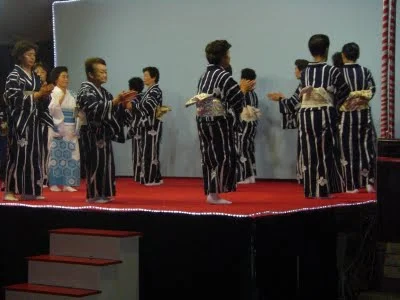
At the end of the stage performances, the Japanese classical dance was performed. The old woman performer showed her skills at the stage and dancers came down to the ground to join with the public. The public also joined with the dancers and they made a circle, moving slowly with a dance steps around a tree. It was a perfect example of cultural fusion point. People from different nationalities, most of them from India, joined in the traditional Japanese dance.

It was 9 O’ clock in the night and still the music was in the air compelling people to dance with the steps shown by the elder performer at the stage. People were not tired even after making several round around the tree with dancing steps. Departing seemed painful for many people.

The next day, while going to office I could see some people still sitting around the stage and park as if they did not like to go back. This is the gloomy part of any festival. The festival and celebrations will be over, but still people carry the memories with them.

The good moments they shared in the social gathering and celebration linger in the mind. That is one of the purposes of festivals. The sweet memories tempt people to organize and join for festival in the coming years too. This is what we also do, waiting for the next year’s festival. Such small hopes are the bigger motivations for life – essential drivers of social life.

Sunday, July 26, 2009

Dancing to the tunes of mele music – Edogawa ward festival at Komatsugawa

When the cute and beautiful girls flowed to the rhythm of the Hawaiian music, the stage looked magnificent. The little girls trained by a professional dancer were literally like waves in ocean. The Polynesian dance Hula is one of the most widely performed and popular dance forms in Japan.
Hula dance was performed by kids on the stage built for Edogawa ward festival organized at Komatsugawa park. Our aprtment's doors open to the Komatsugawa park and it was a nice experience watching and mingling with the local community for almost 4 hours. The programs started at around 4:0 in the evening.

The stage was built for the Annual ward festival. The Edogawa ward festival was organized by local leaders of Edogawa ward. Festivals are common in Japan and it helps people to gather at public places, see each other, refreshing relations and chat with each other. The daily life is busy and nobody have time to stop and chat even for a while. People might be seeing each other while travelling in trains or at shopping malls, but there are very few opportunities for them to get mixed up and come to know each other.

There were stalls being built on the Komatsugawa park for selling fast-food. The temporary stalls with tarpaulin were run by people from different apartments. Indians in Komatsugawa are also an influential group of minority. Yesterday there was a bolly-wood style Indian dance performed by Japanese dancers. The influence of India at Higashi Ojima area is much higher like in areas of Nishi Kasai, Ojima etc. Indians groups were also running some stalls for selling Indian food items, cloths etc.

Such festivals are good opportunities for the local Japanese people and other foreigners to know each other and are platforms for cultural exchange. Today also there are Indian classical dance performances by Indians in Higashi Ojima.


Almost all were thrilled by the hula dance performed by Japanese kids. The Hula dance form was originally developed by the Polynesians who first settled in the Hawaiian Islands. The attraction of Hula dance is the flow in the body movements of dance performers. The body becomes waves like the oscillations of ocean waves. The Hula dance style is performed with a chant or a song called a mele. The Hula dance dramatizes the stories sung in the 'mele'. Unique to the Hawaiian Islands there are many variations and styles of Hula dance.


The dance performance by school girls and other groups were also impressive. There was funny games for the elders to build the tallest structure with the empty cool-drink tin-cans. The wind was moderate and still many of the tin-can castles made were collapsed. The scene reminded me of the expected earthquake in Tokyo, which is feared to happen in any of the future years.


One of the Indian stalls was selling Samosa, Fried chicken, Rice and curry. Butter chicken curry and rice also attracted many of the Japanese people which was run another group of Indians. In between there was a stall for Indian cloths. Japanese noodles and tempura stalls also were crowded. Beer is a natural drink during such festivals and not at all considered as an alcoholic beverage.

Gatherings give enough opportunity to mingle and helps remove apprehensions whatever some people may carry in their head during daily living. Japanese people are open minded to accept other cultures. There are many stereotypic misunderstanding about for foreigners both in Japan and outside world. Many of such concerns have roots at some of the books written by western travelers long years back. An Indian view of Japan is much different from the Western view. Festivals are part of Indian society too and almost all of them are associated with temples and religion in India. I do not intend to enter into the differences in Indian view points and Western view points about Japan.

When we judge a society, first we have to be part of the society. Judgment of a person who separates himself from the society he judges and starts seeing from his cultural point may not do any good to anybody except for him to write a book.

Festivals of this kind give opportunities to know the Japanese psyche in more depth, of course by mingling with the local community, not by keeping ourselves away from them!

Monday, July 20, 2009

Reflections of exotic stones, greenery and Japanese history in a pond

Her tears fell in to the pacific and there arose a group of islands called Japan. There are many myths associated with old Japanese culture. The Goddess behind the creation of Japan may be a myth, but when I read the pamphlet distributed at the entrance gate of Kiyosumi gardens, I recollected the mythical story.

The artistic and beautiful stones laid around the pond in the Kiyosumi gardens were being collected from all over Japan. Thus while stepping on each stone, I could feel that I walk all around Japan! It is an imaginative feeling I shared with my family when we visited the Kiyosumi gardens on a Sunday.

Kiyosumi gardens located near to the Sumidagawa river in the Shitamachi area of Tokyo is very near to Monzen Nackacho. The Kiyosumi gardens is just a few minutes walk from the Kiyosumi shirakawa station in the Toei Oedo line. For us coming from Higashi Ojima, there is one transfer from Toei Shinjuku line to Toei Oedo line at Morishita.

There were groups of people lead by a guide, but we opted to be independent as understanding Japanese was still on the half way for all of us. The pond has three islands and a building where we saw some people practicing meditation. It reminded us of the Buddhist monasteries at some remote village. But the information written on the English leaflet says the building is a tea ceremony space architecture.
Rainwater is used for pond at present, but in old days water from Sumidagawa river was brought into the gardens. Thanks to the Iwasaki family who took the pain to collect all those beautiful stones from all over the Japan and brought them here in this part of Japan by steamships. Those exotic stones now decorate the pond and the surroundings. For that reason the Kiyosumi gardens may look like a stone garden. The tea ceremony building mentioned earlier is known as Ryotei in Japanese. Ryotei was builit as a guesthouse for the visit of British military personality Lord Kichener.

My kids could enjoy the fishes and the tortoises and the ducks in the pond. There were pigeons as well sitting on the stones. We walked towards the Ryotei building stepping on the stones laid in the pond. We could see a big stone monument in which a poem was inscribed. Sitting on a nearby chair we could recognize that the poem tells about a frog who jumped into an old pond. The monument stone was originally located on the banks of Sumidagawa, but was moved to the Kiyosumi gardens when the protection walls were constructed along the Sumidagawa river bank.

The shallow parts of the pond have stepping stone pathways that looked amazing for my kids. They enjoyed the scene of fishes and tortoises while crossing the pond and found the reflections of trees in the water. After walking a while we took rest and gave food to our kids. The climate was ideal for an outing with family with low sun but clear sky.


The tallest hill in Kiyosumi gardens is known as Fuji-san, resembling the name of Fuji mountain. There were Crape myrtle flowers in the garden. We were not tired after walking one round around the pond. On our way back to the exit gate which also the entrance gate, we could meet warm-heated Japanese people greeting while passing on the way. The garden was built by a business magnate Kinokuniya Bunzaemon, who lived in the Edo period.


The entrance ticket charge is JPY 150 per adult and for children, admission is free. It is a place recommended to be visited in Tokyo and which is worth to visit as we can recollect some part of the history of Japan while walking through a typical Japanese garden. Kiyosumi gardens is designated as “Scenic Park” by the Tokyo Metropolitan Government. The pond inside the Kiyosumi gardens reflects the history of Japan along the with the reflections of the exotic stones and the trees.

Saturday, July 11, 2009

Arakawa River, Nakagawa river and Barbecue square in Komatsugawa

Narcissus would love to spend times unlimited on the bank of this river Arakawa where we used to spend evenings on weekends whenever possible. Though little bit embroidered with Boeotian mythological hero’s passion to his own reflections, the beauty of Arakawa river banks offers more or equal attraction to the residents in Komatsugawa.

The barbecue square built on Arakawa river bank is an ideal meeting place for many of the locals here in Komatsugawa. Nakagawa River is another river flowing parallel to the Arakawa River. Two rivers flow parallel and an aerial bridge going exactly at the middle of the rivers from Funaboribashi bridge to connect to the national highway makes the whole scenery stimulating.
The entrance to the Barbecue square is towards the Komatsugawa play ground. There was a professional acrobat who was performing his skills on unicycle with multiple pieces of juggling clubs. Clad in professional gymnastic dress, he was not reluctant to wish passers-by. My daughter was surprised and keen to watch his performance and insisted to stay there more. The older gymnast, when reached near to us did not forget to wave his hand and touch my daughter’s hands. She was thrilled literally. The week-end evenings at Komatsugawa play ground give more opportunity to mingle with the local community.


The barbecue square is a well maintained place, where visitors also take care not to spoil the beauty of the nature. The garden is with many trees and beautiful flowers. White, Yellow, Pink and Blue flowers in a mix of green leaves and the light blue sky at the top of this part of the earth, with a dome at the mouth of Arakawa river presents euphoric days out of the concrete walls.


The life in flats, that also in the midst of a jungle of concrete buildings has been a new thing for us. Being come from a place where transformation of lives from the feudal persuades to the industrialized one is still at a confused stage, we had not been with negligible stress due to a sudden change. Transformation from single family houses to multi-dwelling apartment, where we may never meet neighbors for the whole stay in Japan is something a new experience for my mother too.


The Arakawa River and the Nakagawa River flowing to Tokyo bay with a long stretch of river bank with vetiver grass is rich with eco-system. We could see small frogs while walking on the road near to the river bank. I told my daughter the story of a frog that waited on the river bank for his friend to come from a far away village on a rainy day. Spending time with kids is a good way of reducing everyday stress. The stories are never real and kids never want them to be real. The colorful stories will deviate from the original story and mix with many local additives. She was happy to walk with me on the road parallel to the stretch of vetiver grass.


We never felt come back home. The days are becoming longer in Japan again. Sun is yet to set at the horizons of the land of rising sun. Thousands of boats might have carried loads of wood and food through this river from far away places to Tokyo. Arakawa River might have seen years of human transformation and making of one of the most intelligent society in this part of the earth. Still Arakawa River flows silently. That is the way of Samurais – rich in knowledge and thoughts but still silent!


Sunday, June 14, 2009

A day out listening to the murmurs of sakura leaves in Komatsugawa Park

The weather was good with moderately warm environment. The shadows played hide and seek game with the light. The shadows were dark grey in color…..shadows everywhere in all cases are colorless. Shadows may have nothing to do with dreams. With leaves of sakura trees and maple leaves immerse in dreams with tantalizing murmur, the Komatsugawa Park looked more pleasant.

We could see ants and centipedes crawling. That was one fine Saturday we decided to eat out at the Komatsugawa Park. There were Japanese people sitting on the wooden benches in the park. Eating out is a common thing in Japan. Holidays are more enjoyable when all family members relax under the shadow of trees with small kids playing nearby.

The life in Japan is calm and quite. For senior citizens, Japanese government will take care of all medical expenses. They also get pension from government for their daily living. Ward offices will pay money for small children. Children below the age of 3 get 10,000 Yen per month from the ward office. Children above the age of 3 get 5,000 Yen per month till the age of 15. Many of our friends in Japan will buy toys and new dresses for their kids with this money. The money will be credited to the bank account of head of the family once in every four months.

Our children stopped when they saw a cat on the park. They insisted me to take snaps. The cats in Japan are also disciplined well. He posed for us! A grandma walking near to us stopped and watched us. She looked keen and expressed surprise by seeing our daughters.

The Komatsugawa Park is just less than one minute walking distance from our apartment. In fact the apartments name itself is Komatsugawa Park Mansion. Japanese gardens and public parks are well known for the maintenance and cleanliness. The visitors to the park with their pets, mostly dogs take care to collect the fecal droppings from their pets in a plastic bag and carry it along with them! The public discipline and regard to the law and order is at highest value in Japan.

The dogs in Japan are well cherished by their masters. Most of the dog lovers treat their pets more or the same way as their kids! Sometimes they will be carried to public places on a stroller with all kind of royal attention! The grandma looked astonishingly on us also carried her dog. The dog was silent even after seeing the cat. The scene reminded me of the Japanese lessons we had at OVTA in which the life of a dog was described. The dog in that story was jealous of the cat that was lazy and desired to be at master’s home everyday without doing any work.


The climate has been favorable for a full day out with kids. The coming weeks will witness much rain compared to the foregone days. After the rain Japan will be hot. While walking back to home, we saw the cat still watching on the birds sitting on the bushes. Cats pay more attention and concentration in each and every action than us. As we stepped back home, the sakura leaves whispered to bushes and the cat was still listening to it.

Wednesday, June 10, 2009

Japanese language class at Higashi Ojima Bunka Center – Higashi Ojima Nihongo

It was quite difficult for me to write my name in Hiragana when the organizers of Higashi Ojima Nihongo - Japanese class at Higashi Ojima culture center (Higashi Ojima bunka center) told me to fill up the interview form. I could manage to write name, address and other details in Katakana, a little bit of hiragana and some portions of the address in Kanji also.

For some initial months after coming over to Japan, I had an elevated interest to learn Japanese language. That was the time my first nihongo (Japanese) sensei (Teacher) Mr. Kennichi Tabe (Tabe-san) started teaching initial lessons of Japanese along with the classes at OVTA. I found myself enjoyed learning from Tabe-san, though it was an informal way of teaching.

Sometimes we learn more from casual way of teaching than from professional teachers. The Japanese classes at Higashi Ojima culture center is one of such an easy way of learning Japanese. The teachers are volunteers who teach foreign people who are interested to learn Japanese at a nominal fee of 500 Japanese Yen per class.

One class will be around 1 hour 30 minutes. The first lesson is free and is considered as a trial for the students. Being a student at this age is a funny thing. Anyway, life is a continuous process of learning and we are always students in life. Life teaches us many things in due course of its flow. Some people learn fast and some lag behind. That learning process is different from language learning process.

It is a one to one classes, means for one student there is a teacher. It is convenient to learn from the teacher as he/she is fully available for the total class hours. Though a bit informal, I enjoyed the first day of learning from Higashi Ojima culture center Japanese language class. There were around 12 students, some of them are quite older than me!

When my colleague, Mr. Remus sim found this new way of learning Japanese language for me, I was little skeptical on the timings. The timing of the classes at Higashi Ojima cultural center is from 7 PM to 8:30 PM. There will be one class in a week. Here in Higashi Ojima, it is on Wednesdays. If there are five Wednesdays in a month, the last Wednesday will be a holiday. Totally, there will be four classes in a month.

Language learning is more a personal effort than a teacher’s ability for the grown up people. For children, to a great part, it depends on the skill of the teacher also. I did not put much effort for the past many months to learn Japanese language. Learning Japanese will make the life in Japan more comfortable, though it is not really required for the work. For many people working in multinational companies in Japan, Japanese language is not essential. Many of them stay long in Japan and still be able to manage the life only with Ohayo gozaimasu, that also with erred slang.

My colleagues are wonderful friends who have been helping me for every walk of life. They talk on behalf of me sometimes to clarify doubts raised by water and sewage department or electricity departments or sometimes with Yahoo BB. Due to the inability to speak Japanese language, the life in Japan is that of a kind of dependent, but of good friends. I am fortunate to get good friends in Japan including some foreign friends and Japanese friends. Remus found the Japanese classes for me and Iwabuchi-san talked on behalf of me with the organizers of the Japanese language class. After talking with the organizers, she informed me that there is one more Indian national attending the class at Higashi Ojima.

Today’s Japanese lesson was interesting and worth. The Higashi Ojima bunka center is near to the Daiei in Shin Ohashi dori, right after the exit of Higashi Ojima station at Toei Shinjuku line. We have to walk 7 minutes from the station to the bunka center. The classes are at the third floor. After all learning is partial process. Student must invest own interest and effort than the teacher! You need to inform over phone for the first day or contact directly to the class and explain.

Find the map here to reach at the bunka center and attend Higashi Ojima Nihongo

Sunday, May 31, 2009

Thoughts on Japan, society and Japanese people

Walking down the street, we had an interesting discussion with us. How came the Japanese so different from other East Asians? Discussed in many social forums may be thousands of times by veterans, these topics are still alive, but I particularly had nothing new to add to my opinion. Choi bun-san had something new to tell me.

Being from Korea, he knows well that the physical difference between most of the East Asians and Japanese is almost zero, especially with the northern Chinese and Koreans. The looks are similar, but when he says the attitude and behavior is different I had to agree. How can I, better than him be able to differentiate similar looking people. The race is same, the physical appearances are same, but there are still elements that separate Japanese people from others.

The culture, the language, the behavior, the response towards events etc are different. This does not mean that Japanese people are free from all kinds of bad manners or they are extra ordinarily obedient or disciplined. When I say from my own experience that Japan is clean, people are disciplined, law obedient, well-mannered, free from social crimes, I never mean that Japanese society is one hundred percent free from all kinds of dirt, indiscipline, law breakings, ill-manners, anti-social activities etc.

There may be bad people in Japan as it is with any society. There are dirty things, there are unclean areas, there are violations of law and rules, there are aggression in the public places, there are murders, rape, child abuse, there are drunken people shouting in public places, hundreds of cases of anti-social activities reported from Japan and thus goes the list of all bad things in society just the same way like in any other society. Japanese people are not extra-ordinary people in the sense that they are just like the same kind of human race as is with any other human population. Japanese people are extra-ordinary in their attitude to eliminate or free themselves from many of the evils in our societies. That attitude makes the difference. That attitude of Japanese people reflects in their whole education system and social fabric.

It is just that! But this is the great thing with any human population. The attitude and nature of majority of Japanese people are warm, welcome, pleasant and optimistic towards others and their own life. Is it not the same with other east Asians? Are they not warm and pleasant? Of course, Yes. They are also good and their societies are also warm. Just the percent of that elevated class of human beings are more in Japan. This makes the difference and projects Japan in a well frame to the rest of the world.

Choi bun-san had his own versions to justify his observations. I have very few opportunities to know more deep about the real Japanese psyche.

Who is bad and who is right? How can we judge people without any prejudice? When we make standards for measuring or observing or judging other characters, always those standards will be affected by our own views. Then those standards cease to be neutral. In fact, there may not be any neutral standards by which we can measure human beings and their behavior. We are not better judges of anybody.

It is heavily raining outside as I started recollecting the conversations with Choi bun-san. Today’s News paper head lines carry the news of war planes reached from America to Japan.

Japanese society has been peaceful and quiet for many years. The life here is also peaceful and calm. Japanese society is well taught to respect each other and respect strangers. The Bushido culture teaches to respect the enemy too. Historical evidences shows the fighting communities within Japan respected each other in war.

Napoleon Bonaparte, after capturing Russia, decided to return back without touching China. The reason he told to his military was that it is a sleeping monster. Sleeping does not mean weakness. Japan is not weak only because Japanese people love peace.

My Experience with POVO After Leaving Japan - A Caution for Foreign Residents

When I was living in Japan (until May 2023), I used KDDI mobile services for many years without any issues. When I was transferred internall...