Thursday, May 21, 2009

How long a queue can go? – Swine flu and the queue for mask in Japan

Wong-san was desperate that he could not grab a packet of mask when I met him in front of Ito-Yokado. Swine flue is spreading in Japan. The news flash in television and newspapers goes like a wildfire and people are worried about the coming days.

Prevention is better than cure. Precaution against any kind of spreading disease is better than getting it and treating. When the life enters to a certain degree of improbability or uncertainty, we feel insecure. Japan was under a grip of strong sense of security against many kinds of social crimes and spreading diseases. It seems, the life here was going smooth for many years after the World War II. Uncertainty brings panic.

Wearing masks is only a protection, but it is not a prevention of death! Who can prevent the death? Masks are only a hideout from the enemy. If the real enemy is within ourselves who can save us! The immunity system within our body is the one which can safe guard us to some extend from the spreading diseases. Unfortunately it is not developed in one day or just by wearing a mask. After all who can guarantee the life? Can the God guarantee?

Most of the Japanese do not have proper faith in God. It is a kind of atheism that got prevalent dominancy in Japanese society. Gods never saved Japanese people! Fortunately there are not many Gods in Japan. The one who is being worshipped, Buddha, really denied the existence of God by himself in all his teachings.

Instead of standing in long queues in front of a temple, Japanese people would prefer to stand in queue in front of a medical shop or any other shop to grab a packet of mask. Japanese people rarely wear mask if I put their natural habits in a double meaning. But they wear a mask when they get flu or before the start of blossom. Some people are allergic to the pollen grains.

This time it is the swine flu which is terrifying the routine Japanese life. Commuter trains are heavily packed and the chances of getting affected are much easier in public places.
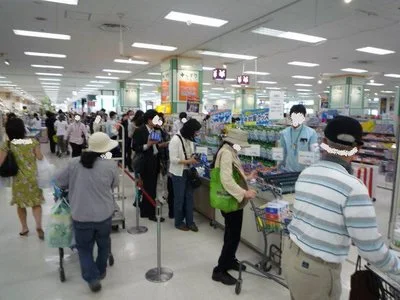
When we went for lunch at Makudonarudo (Mc Donald), Remus-san has taken some photos yesterday. Remus told me to write about this queue with photos. When Remus visited some other places in Tokyo, he saw some shops displaying banners with “Masks sold out” No more masks available etc. Interestingly some shops had more than one banner with the same caption. The shop owner may want to invite the attention of customers looking for masks. Two banners can not be neglected by many of the customers!


Today the queue was much longer in the Ito Yokado. People are really scared of the swine flu in Japan. Mask manufacturers, distributors and shop owners will make good business. They have employed some extra staff for controlling the queue.

Swine flu, God and Mask do have some thing in common as Death, Disease and Pollen grain do have. The only thing remaining mysterious is the queue. How long a queue can go? The queue for mask and the queue for swine flu – both are competing for the length of queue. The queue for God is getting shorter day by day.

Swine flu is called and influenza in Japan. The pig fever is not a favored one. Probably Japan is one of the biggest markets for pig meat. The swine flu was brought to Japan by some of the students returned back after visiting Canada. Now Japan is the fourth worst swine flu affected country.

The spread of swine flu is not good for anybody for sure and the harm it does to the Japanese society will be much deeper as is it with any other country. The sale of masks has gone high upto 30 percent since the news of swine flu in Japan. The goruden uiku (Golden week) holiday tours are also negatively affected due to swine flu.

Pigs can really do much harm to human beings than we think! Did we underestimate the pigs? They are not just pigs. They also stand in queue in the slaughter house. The life for them is also uncertain when they stand in the queue waiting for their turn to be butchered. It is that uncertainty from their mind spreading to human beings now. Darwin smiles sarcastically.

Sunday, May 17, 2009

365 days of blogging life in Japan

If time, hours, day, months and years have something to do with human life, today is one of such important day in my life. May 17 had witnessed important events in the life earlier also. I don’t believe in celebrating my birthdays, but when it comes to notify my friends that it was on May 17 last year I started this blog, I should not hesitate to do so.

Yes, today is the 1st Anniversary of this blog. My life in Japan is one year old today!

Dear Blogger friends, your valuable suggestions and comments are anticipated. Thanks in advance.

Day and night, as written by Hawking, may probably be a relative phenomenon depending on the position of the observer. Though observed from within the mind, it was not so long ago that this blog started appearing in the google searches. The land of rising sun has ignited enough thoughts at the hearth of the mind.

While commute on buses and trains, the observer within was silently witnessing the activities outside. The observer inside was restless to learn new things when talking with Japanese people of different nature, while interacting with them and while reading through the culture of Japan and the society. It was this restless learning of new things in Japan that formed the reason for the birth of this blog.

Blogs does not happen automatically, but happens out of a restless desire to express own feelings and opinions, to share the new knowledge we learn in life, to find out a vent for nasty emotions generated out of the unpleasant experiences from all corners of life.

This blog on my life in Japan was a product of such restless mind and disorder. The disorder, not only in the society, but also within, urges for order on everything comes in contact. This blog did not happen out of sudden spurt of emotions in favor or against anybody, but happened out of a strong desire to tell the world outside thorough what I have been going through in Japan. The world outside including my relatives and friends responded equally well since the birth of this blog.

Today is the 365th day of blogging life in Japan. Google provided a blogging platform where I stand and share with the rest of the world what I have been experiencing in Japan. Thanks to all those who have been visiting this blog. Special thanks to Manisha and Anima for following this blog. I have learned many new things from their blogs.
Have a nice day to all readers!


Signing off ..........

Best Regards
Jayaprakash
May 17, 2009

Katakana writing system in Japanese and interesting pronunciation of English words

One of my friends Tom-san do not like the Katakana. The reason she tells is very simple – why Japanese people change the English? She likes Hiragana. For me too Katakana looked awry at first, confusing till now.

When Morishita sensei started teaching Katakana characters at OVTA, Kahin Makuhari, we were telling jokingly that we will forget the hiragana characters that we learned earlier. That was true to some extent. We felt difficulty in recognizing hiragana characters when katakana characters started occupying the brain!

For the same pronunciation of Hiragana characters, there are equivalent katakana characters. This means Katakana and Hiragana are two parallel systems of writing same sounds. Hiragana is used to write words of indigenous origin, while Katakana is used to write Foreign words.

Identifying a foreign word is thus easier in Japanese language. Hiragana in combination with Kanji makes all the indigenous words in Japan and Katakana stands for foreigners!

The trouble is recognizing the foreign word once it is written in Katakana. It is really a mind boggling experience for many foreigners or at least for me! I take a bit time even to read my name written in Katakana. In Katakana, my name will be twisted as ‘Ja-ya-pu-ra-ka-sho’. Fortunately my name is not much twisted and can be easily recovered back to its original shape.

There are certain words in English that Japanese people use and write in Katakana, reading and recognizing which for many foreigners is a brain teasing game. One such word for me is goruden viku. When I encountered this word last year for the first time in a product advertisement caption, I thought of it for quite some time and then started guessing by connecting it with English words. I related all the coming events in the near future in the attempt to retrieve the Japanized foreign word. Finally I recognized it as ‘Golden week’.

Ra-ji-o is another word that cracked my brain. The funny word ever I heard is ‘Kombini’. It was very funny to hear from our Morishita sensei about the Kombini. Kombinis are really Kombini in Japan. She told about the shortening of long word to smaller ones by Japanese people. Then I remembered the manufacturing concept of Japan to make things smaller. Small is beautiful in Japan. So is what happened to the Kombini. Kombini is the shortened for of ‘Convenient store’ used by Japanese people. Morishita sensei said jokingly that Kombini is her kitchen.

I was also depending on Kombini for food till April of this year. In Japan, convenient stores, particularly the a.m p.m are opened for 24 hours. They are called as ‘am pm’ also and are really helpful to bachelors in Japan.

Hoto kohee (hot coffee) is the one I prefer to drink at Maku donarudo (Mc Donald). After lunch we go to the second floor by Esukareta- (Escalator), though there are Erebe-ta- (elevator). At the second floor of Ito Yokado, there are sutoa (store) of Terebi (TV), pasokon (personal computer) and other electronic items as well as some resutoran (Restaurant). Down stairs have stalls for Nekutai (Neck tie), puresento (present, gift) and have a supa (super market). During December, there will be special sales for Kurisumasu keki (Christmas cake). Items from Supain (spain), Itaria (Italy) etc are also available in the shops.

Why Japanese writing system modifies the foreign words. The answer is simple. Japanese language has simple pronunciation based on 5 different accents. They are;

A (sounds like ‘a’ of a ‘cat’ and the ‘u’ in ‘put’)
E (sounds like ‘pet’, ‘set’, ‘get’ etc.)
I (sounds like ee in ‘keen’ or ‘see’ but somewhere shorten like ‘sit’
O (sounds like the one between ‘taught’ and ‘pot’
U (sounds like the u in ‘put’ but the mouth corners may pull back a bit)


It seems, the Japanese people fit all the words in to the five sounds. Certainly there are many other sounds in foreign languages. In order to write them and fit them to readable and writable in Japanese language, the foreign words must be twisted and forged to make it Japanese! Thus the Japanized version of foreign words becomes very funny to foreigners.

A cake might be tasty to everyone, but how about if some Japanese ask you if you want to eat a keki?

Living with kids in Japan – Free medical insurance scheme for children

One of the Japanese Kanji character I like most is the one for Child. The Kanji character for child is 子. By simply writing 子 we can understand it stands for ‘child’, ‘children’ etc. Pronounce as ‘ko’ in kun’yomi and ‘shi’ in on’yomi 子 is one of the simplest Kanji very easy to write and remember. But in Japanese language, child is Kodomo. Then the first sound ko is written as 子 and the remaining ‘domo’ is written in hiragana. There are some occasions where the kodomo is written as 子供.

Thus the Otoko no ko becomes boy child and onna no ko is girl child. When I approached the health insurance section of ward office, they inquired me about number of children. I replied in my broken confused Japanese ‘onna no ko wa futari desu’. I am not sure about the grammar, but they could have understood.

子 is a widely used Kanji helpful in many life situations in day to day life in Japan. Combined with other kanji characters 子 forms different meanings like the one in ‘suki’ which means ‘like’, ‘loving’ etc. Interestingly when I learned the kanji for suki, it is a combination of a child and woman. Woman loves child naturally and that love is considered from the heart which Japanese people think will convey the best meaning for love and like. This has prompted me to think the complex mind process involved in the past years to derive the Kanji characters. 子 is used in Choushi which means ‘tune’ or ‘condition’ and in ‘yousu’ means ‘state of affairs’. I can not proceed further with my meager knowledge on Japanese Kanji.

Coming to the subject of living with children in Japan, it is a fun and different As I wrote in the previous post, the alien card for children will be issued on the same day by the ward office. Once the alien card is received, we have to apply for National health insurance or other health insurance schemes. This will provide 70% free treatment in hospitals and medical stores. We need to produce the health insurance card to the hospitals and medical stores. The first time the hospitals and medical stores will register the card details in the system and subsequent visits will be easier by just giving the card to them.

70% free medical insurance is a great help, the Japan Government provide to Japanese people and for foreigners who intends to live in Japan for one year or more. Generally speaking, people who have alien card will be covered under one of the national health insurance schemes. So, they can avail 70% free medical treatment. The health insurance card is a green colored card with the same size of the alien registration card.

For children under the age of 15, ward office will issue another health insurance card. The green health insurance card is required to apply for this special card for children. If we produce both the cards in hospital and medical stores, 100% of the medical expenses will be free. This was something new information for me on the conveniences the Japan Government provides to the citizens including temporary foreign residents. How can we say Japan discriminates foreigners! I wonder. Temporary foreign residents are also covered under the national health insurance scheme and national pension scheme and their family members are also entitled to the facilities provided by the Japan Government.

I am not sure whether the child’s medical expenses card for 100% free treatment is available in other ward offices as well. Edogawa ward office had issued these medical expenses cards for my children. The diagnosis and treatment for which the medical expenses become free are slightly different. For example, child’s vaccination fee, health examination fee and the charges for using rooms are not covered by health insurance plan in Japan.

This free medical treatment for children is available even in case we travel out of Tokyo and fall sick in other part of Japan. In such cases, we need to get the receipt or expenses, health insurance card, child’s medical expense card issued by the ward office, and the guardian’s bank pass book to the ward office’s respective sections.

Children will get infected with the seasonal diseases and common cold easily and every time parents has to take them to the hospital. Thanks to the Japanese Government, due to the free medical treatment schemes, the life in Japan with kids will not be an additional financial burden for parents.

Living with family in Tokyo – Alien registration card

To be frank, I was little bit skeptic before coming to Japan, for conditions of a foreigner to live in Japan with family. This was due to the biased concerns over the cultural differences. Though we have learned about Japan in school books that Asian cultures have similar root and have many things in common, the fear remained in mind till I personally witness the good receptive attitude of Japanese people.

It was on April 10 of this year, more than one month now, wife with two kids and mother moved from India. The first thing to do in Japan once the immigration procedures are completed and reached at the apartment is to apply for Alien card. For foreigners, Japan Government issues Alien Registration card. This card is the identity card for foreigners in Japan.

Called ‘Gaikokujin Toroku Shomeisho’ in Japanese, the Alien registration card is a must to carry along always. Foreigner could be asked to produce it at any time by the law authorities including police at any time during travel in Japan. We have to apply to the respective ward office as early as possible since many other documents required for living in Japan depend on receipt of Alien card. To apply for alien card, the required documents are original passport and two passport size photographs taken with the last 6 months.

In ward offices, called as Kuyakusho in Japanese language, there will be English speaking staff at foreign registration section. The reception at the Kuyakusho will guide you to the proper counter. When I went to the Edogawa kuyakusho to apply for the alien cards for my wife and children, the receptionist guided us to the registration counter. The lady staff at the foreign registration cell could communicate to us in English. She handed over some forms which are written in Japanese and English and explained to us what information is to be written.

Since we went to the ward office with our children, some of the staff at the counter came out to see our kids. One staff gave some toys to my elder daughter to play so that she will not get bored. I filled up the necessary information and submitted at the counter. She told us to wait one hour. Generally foreigners above the age of 16 years will receive the alien card after approximately 20 days. For children below 16 years old, the alien registration card will be issued on the same day. That is the reason she told us to wait and gave toys to the kids for playing.

We talked with other foreigners waiting at the counter. Alien registration card is required to apply for health insurance card and to apply for telephone connection or mobile phone connection. Yahoo BB application also asks for photocopy of alien card.

After almost one hour of waiting, we were called to the counter to receive the alien cards for our kids. They informed, the alien card for wife will be issued after 20 days at the local ward office branch. It can be collected by showing the passport in which a copy of the application for alien card is attached. For kids, the size of alien card is different. It looks more like a folded pass book. For elders, the alien card is similar in size of an ATM card.

Now we realized that our fears before coming to Japan were baseless. Japanese people are warm and pleasant. The staff at that local ward office branch where we went to receive the alien card of my wife were also very kind to direct us with more useful information on how to fill up the application forms for health insurances for kids.

More details about the procedure for application for alien card can be read from; Useful information on Alien card application

Friday, May 15, 2009

Challenging Situation at Chennai Airport While Returning to Japan

One of the challenging situations that I had faced was at the Chennai Airport. I was traveling to Japan with my family and mother. We took a domestic flight from Kochi, Kerala, to reach Chennai Airport, from where we needed to board Singapore Airlines.

I handed over the copies of our flight tickets and passports of all my family members to the airline staff after a long wait in the queue to get the boarding passes. After examining, the staff asked me to show the copy of the credit card by which I had booked the flights.

I used the support of one of my colleagues from Singapore to book the flight tickets. He used his credit card to book the flight tickets on Singapore Airlines for me. My colleague had cautioned me about the importance of carrying a printout of the copy of his credit card when traveling. I did not carry the copy of his credit card, and the staff informed me to bring the copy in order to travel on Singapore Airlines.

I tried to appeal by saying that the Singapore Airlines staff did not insist on such a document when I traveled from Japan to India. The staff showed me the remarks at the bottom of the tickets stating the importance of carrying a copy of the credit card if the booking was done through another person’s credit card.

It was almost certain that we needed to postpone the travel to another date until I get the copy of the credit card from my colleague. We moved out of the queue so that other passengers could proceed smoothly. After a minute’s pondering, I decided to call one of my old friends in Chennai and seek his help. I called and explained to him the situation. He told me to keep cool, and since the General Manager of Singapore Airlines’ Chennai office was his friend, he would try to make an appeal for my case.

When I was waiting for my friend’s call, a lady staff member appeared on the scene. She was talking to someone on her mobile. When she approached us, she extended her hands for a handshake and asked if my name was Jayaprakash, to which I said yes. Then she handed over her phone to me and told me to talk to the person on the other end. The voice at the other end introduced herself as the General Manager of Singapore Airlines. She said she talked with my friend in Chennai, and based on that verification method, she has requested her staff in the Chennai airport to issue boarding passes. She wished us safe, pleasant travel back to Japan but advised us to book the flight tickets with our own credit cards as much as possible.

We traveled back to Japan thanking my friend in Chennai and also the general manager of Singapore Airlines.

Lessons I learned from that experience:

1. Pay attention to each and every detail, however small it is. I did not take seriously the instructions given at the bottom of the flight ticket.

2. Use your own credit card for booking the tickets. If a credit card is not available, then take a physical copy of the authorization letter from the person whose credit card is used for booking.

3. Move a bit away from the problem and think about a solution. While staying in the middle of the problem, we may not be able to think about a solution.

Sunday, May 03, 2009

Japanese discipline – obedience to the law and order in Japan

Discipline is part of Japanese culture. It is neatly interwoven to the psyche of each Japanese citizen. It won’t be much exaggerating if I say Japanese people are obsessed with discipline.

There was an interview for foreign staff at the work place last year and I was being asked by the interviewer ‘what is your impression about Japan and its people?’

Well, that was an interesting question to answer. Almost naturally, without thinking I answered ‘Discipline of Japanese people’. The interview board was interested to know more about my impression on the discipline of Japanese society. One of the members asked me the spelling of the word discipline. He wanted to check the exact meaning of discipline in his language translator device. He asked me and I spelled D-I-S-C-I-P-L-I-N-E.

Probably ‘discipline’ is a bit difficult word for many Japanese people to pronounce. Most of them make mistake in writing discipline and they may write it as ‘disipirin’. The L and R confusion of Japanese people is very well known to them as well as to the foreigners in Japan. Japanese language has only one sound for R and L, the sound of which is in between RA and LA. Then, to many Japanese people, the ‘Light’ will be the ‘Right’ and ‘Law obedient’ will be the ‘Raw obedient’. I remember reading a site ‘Old brains learn New tricks’ in which the difficulty of Japanese military to distinguish L and R is expressed though an example when the GIs in the Pacific theater chose passwords overrun with R's , words like "rabble-rouser" or "rubbernecker." The reason was the Japanese people have a 'ell of a time with R, which they often pronounce as "ell."

He got the meaning of discipline in Japanese and we discussed the discipline and culture of Japanese society. The culture of a well disciplined Japanese society is known throughout the world. In school, the teachers used to tell us about the Japanese discipline and the benefits the Japanese society derived out of their discipline. Getting inside the train, getting out of the train, walking to the escalator (Eskureta in Japanese is modified form of escalator) are some of the occasions we encounter the discipline of Japanese people. I expressed my good feelings on the discipline of Japanese society to the interviewers.

By definition, the discipline is the training and control of oneself and one's conduct, usually for personal improvement. Since long, Japanese society had implemented discipline to its social structure as one of its essential constituent element. The Japanese Kanji character for discipline is 訓練. The Japanese samurai culture was based on discipline as the word indicates. Discipline refers to systematic instruction given to a disciple. In one sense the Bushido culture was programmed or instructed social system. Of course those instructions have been proved good to the present day Japanese society.

The obedience of Japanese people has its origin in the disciplined behavior which was instructed from childhood. Small kids will be trained by parents for good public behavior. The obedience to the law, the obedience to the system, the good manners in public behavior etc will be continued and reinforced through teaching in schools.

The culture of Bushido stressed on the importance of discipline. Discipline in English means ‘to instruct a person to follow particular rule, or ‘to adhere to a certain "order." This adherence to the order and the obedience to the order from higher ranking officers made the Japanese military one of the significant forces during World War II. I don’t want to enter into a controversy whether Japanese military was right or wrong during Second World War.

Coming to daily life experience in Japan, I have been observing the public discipline of Japanese people especially in railway stations. The pin-drop silence in railway stations in Tokyo is a live example of the discipline and good manners of Japanese people. The discipline may not be always corresponds to the education only. It depends on many factors one of which may be the level of education. Education does not mean simply holding a university degree, but with a more meaningful explanation, manifestation of the self as 'Swami Vivekananda' emphasized. When the education arms an individual with a powerful social tool ‘Empathy’, the entire society and nation become its beneficiary. Empathy is what many of us lack.

The discipline of Japanese children is incredible! Children too are learned to obey public behavior and rules. Learned from elders, they are not behind any of the adults and on many occasions better than the adults in observing obedience and discipline.

‘Discipline’ is one of the best characteristics of Japanese society, which I admire and would like to proclaim to the rest of the world.

Saturday, May 02, 2009

Memories of a boring golden week in Japan

‘Students walk to school and rush to home’ is an advertisement caption I read somewhere in the newspaper. The reverse was the case for me till April 10 of this year in Japan. Virtually I cursed the week-ends for almost past one year and wanted to attend office to the maximum possible extent. Personal life in Japan was not very exciting as the whole family was miles apart.

For some initial weeks I had nothing to do in Japan on Saturdays and Sundays and that was one of the reasons for this blog too. Last Golden week was a silver week for me as for most part of the holidays I was found myself alone except in occasions together with Mustain-san. When one of my colleagues asked about the golden week holidays, I replied as if I celebrated a bronze week, not even silver!

During last Golden week holidays I was involved in internet browsing and Yahoo answers. Life in Japan with friends is thrilling, but never a lonely life. Coming out of the initial adjustment troubles with Japan after Golden week holidays, I could mingle with friends from other countries and some Japanese too.
This golden week is really more than golden for me as my whole family is here with me to make the holidays happier. Holidays in Japan now are not boring as I have kids to play with. My elder daughter is my companion now to accompany wherever I go. She will play football with me on the ground near to our building. She insists me to go the park and have fun outside.

Life with kids even if we are in hell will be cheerful! Children are natural in their behavior which almost all of the adults lack. The life in Japan with many adult Japanese having the attitude of children are thus more blissful!


When we go together outside especially in trains many Japanese people look at us as we have different face and skin color. I never felt this before as Japanese people have not stared at me as if I am an alien. Now while going with my daughter, some of them look with curious face at my daughter and say “Kawaii ne”. I learned a new Japanese word Kawaii, which means ‘Cute’. I don’t think Japanese people are staring at us, but they just wanted to show their curiosity in seeing a foreign child with big eyes. Many of them show in gestures that she has got big eyes with their fingers folded in circles around their eyes.

That is interesting and we never felt exhausted or embarrassed as we have taken those experiences in the positive manner. No Japanese have shown any kind of antagonistic attitude till now.

Coming back to the golden week holidays, I have good play times with my daughter. In Japan, Golden Week is a group of holidays together in one week. There are four national holidays within this week. During Golden week, Japanese people plan for long outing with their family. If there is a working day in between national holidays, many of the Japanese apply for a holiday to avail long holidays. As per information from friends, Golden Week is one of Japan's three important holiday season apart from New Year holidays and Obon week. The Constitution Day (Called in Japanese as Kenpo kinenbi), Greenery Day (Called in Japanese as Midori no hi) and Children's Day (Called in Japanese as Kodomo no hi) comes on 3rd, 4th and 5th of May.

Even during long holidays, after going out, I rush to return home. ‘Students walk to school and rush to home’ becomes a meaningful caption in my life in Japan too.

Saturday, April 25, 2009

When the castles of good images of Japan falls down in the mind…..

Some of my preconceived notions were getting jolts when encountered with an incident of discrimination though not directed at me. I saw it happened at Morishita Toei Shinjuku station while waiting for train towards Higashi Ojima. Though I tried to convince myself that the acts of racism were not due to the skin color of the victim, I could hardly succeed in convincing myself. There were no other reasons to believe it was not due to skin color. If I could guess correctly, probably it was due to the hate towards a particular race.

And Japan is known for it as many of the personal bloggers declare with their own experiences. I defended many of the negative opinions expressed about Japanese people through this blog.

In acts of discrimination there are always three parties involved. The one who shows the hate feelings, the victim of discrimination towards whom the acts of the racists are expressed publicly and the third one are the witnesses. I was at the third position of witness and was watching the discriminator’s actions as he walked through the plat-form from where the victim was standing in the queue.

At first I thought of not writing about this incident as it may project Japan and its majority good and kind people in a detrimental manner. The discriminator here may be an exception from the vast majority of friendly Japanese people. Though an odd event, I could observe contrary to what I have been telling to my friends that I have never seen any kind of discrimination in Japan. This one of course was pure racist comments he spat on the plat-form with his antagonistic foul mouth.

Let me come out openly with what happened. I was coming down to the plat-form in the escalator at Morishita Toei Shinjuku station. The time was around 6:40 in the evening. The pink car is no more reserved for women. I used to board into the first compartment/car since it will reach first at the Komatsugawa exit by the time the train reaches Higashi Ojima.

There was standing a person who might be from one of the many countries of African continent. The physical characteristics of people including the skin color gives sufficient clue to guess the region and race of them. The person in black was gentle in his position, dress and looks. The moment he entered in a queue, I could see the Japanese young man who was already standing in the front looked at the guy in black and uttered some words in Japanese. The J-man walked away with an angry face and he showed as if he spit on the plat-form. This was to show his unlikeness to the person in black.

We, the witnesses could not see any reason for the J-man’s anger except the one that the B-man stood in his back of queue. They had to travel together once they enter inside the train. The J-man might have dislike towards the B-man’s race. There were no other reason I could guess in mind.

The witnesses of the J-man’s venomous words were just witnessing and did not show any surprise at his action. That is the great thing with Japanese people I have observed. Japanese people have an expressionless face towards many of the events in public.

What was the reaction of the B-man? He was engaged in eating chewing gum as if nothing new has happened. Some of the people walking were looking at his reaction, but he was not looking at anybody. He was gentle in his stand and the J-man was the ugly one showed up his foul mouth at the public place. Who is the winner here!

This one event looks different and dirty among other pages of life in Japan so far. Though not a victim of Japanese racism and discrimination towards foreigners, it hurts my feelings. At many incidents, some witnesses bear deep wounds than the victims. Still I bear the wounds and remember the moment I get down to the plat-form. That plat-form was the place where the castles of flatter on Japan built from the images of beautiful and kind people fell down in my mind. Still I like to believe this is an odd incident.

Wednesday, April 22, 2009

Walking with style on roads – Life is never boring in Japan

The climate here is getting hotter. Yesterday there was a rain in Tokyo. I was told to check out the weather forecast in the morning before going to the office. Initially I used to surprise why Japanese people carries umbrella though it is not raining in the morning. Later in the evening I realized the reason for it. It will be heavily raining and many of the days I travelled back home wet in rain.

Now, I used to check the weather forecast in the morning and if the rain is predicted, will carry umbrella. Umbrella is called Kasa in Japanese language. Rain is called Ame. ‘Ame ga futhemasu’ is ‘It is raining’.

One thing I surprised with the umbrella fashion in Japan is the old fashioned umbrellas are still a fashion in Japan. It is no more a favorable fashion in my country, but still in Japan, it is the fashion. The long walking length umbrellas and golf size umbrellas are more popular in Japan. Both men and women carry long umbrellas, sometimes hanging stylishly on their arms. It is a beautiful scene to observe a pretty J-girl walking with a colorful long umbrella.

Japan is known to its foreigner residents for the crazy style of J-girls walking in the midnight also with an umbrella though no rain predicted in the coming two days! Many times I have found myself stunningly watching J-girls walking with fashionable umbrella at late night in Ginza area with out rain. I asked my friends the reason for it and they told it is simply fashion!

The image of Japan and China before coming to Japan was obviously people with umbrella. The first Chinese traveler Hiuen Tsung to India carried an umbrella on his back in our History books. The image of Hiuen Tsung carrying an umbrella on his back triggered many doubts like why and how they carry an umbrella always. Though the question and answer remained mysterious to this date for many of us, it is interesting to recollect those images of Chinese travelers with umbrella while watching J-girls walking with an open umbrella on the busy roads of Tokyo in the midnight too without rain.

It is just for the style and Japan may be the biggest consumer for fashion items in the world. Japanese women like to be fashionable and wish to dress all the modern stylish cloths. If the fashion needs a dog in hand, they will go out in the fashion dress with a dog in hand. It is amazing to see them walk outside.

This is not a disparagement, but just a few observations, which I really liked about Japan. Japanese people are adventurous and dare to go for a different taste in life always. Even the older generation people in Japan are adventurous and really enjoy in experimenting with different style of looks.

The best part of an intelligent society is to constantly evolve with new extra ordinary things that the life is not bored with usual things. I think, Japan has got many things to make the life exciting each day and the people here of-course are enthusiastic about experimenting with new things in life.

Sunday, April 19, 2009

Shopping experience at Costco wholesale, Makuhari

This was the fourth time I did purchase at COSTCO WHOLESALE at Makuhari after coming to Japan. When Balasan told about Costco and the economical benefits of purchasing from Costco one year before, I was not fully convinced obviously because I was leading a single life at that time in Japan.

Now with family, purchasing from Costco is an economically beneficial. Membership is mandatory to purchase from Costco. Two individuals can do shopping with one membership card. Balasan has taken the membership card for one year. The one year membership card costs 4000 yen without tax.

When we buy household items in bulk, Costco is a good choice, as far as our experience goes. I could see Ready to eat MTR foods from India, which is an attractive item for Indians and Pakistanis in Japan. The cost of 4 Nos of Palak paneer packs cost 898 Japanese Yen. The average cost of one pack is 224.5 Japanese yen. The same Palak paneer from MTR in other local shops in Tokyo that sells Indian foods costs 480 Japanese yen. There are some Indian shops that sell little bit cheaper than 480 Yen but not very near to the cost at Costco.

Another example is the cost of Olive oil. The one liter Olive oil I bought from a local supermarket cost me around 900 Yen, while the one I did yesterday at Costco cost me around 500 Yen per liter, when purchased a can of 5 liters.

Travelling from our place to Makuhari is the only disadvantage for us to shop at Costco. For me, living at Higashi Ojima, I have to take Toei Shinjuku line up to Motoyawata. From there by changing to JR line to reach Nishi Funabashi. From Nishi Funabashi the frequency of trains directly to Kahin Makuhari is less. Most of the time we have to make one more transfer at Minami Funabashi to reach finally at Kahin Makuhari. From Kahin Makuhari we will board the bus that goes to Costco wholesale, Makuhari. There are two buses in every one hour. We have to plan the travel as per the bus timings to save time.

When we used to go to OVTA for our Japanese lessons, it was easier to shop at Saturdays once the Japanese lessons are finished. Vegetables and Food items are much cheaper compared to shopping at local shops. Costco is a wholesale shop whose history dates back to 1976 when it started first sale in Morena Boulevard in San Diego, CA, U.S.A.

First Costco warehouse was opened in Seattle, WA, U.S.A in 1983, Costco have more than 500 locations worldwide. Best part of Costco is it is open not only to business customers, but to retail customers too can avail the benefit of purchasing the things at whole sale price. Costco operates at nine locations in Japan. The branches in Japan are in Fukuoka (Hisayama), Chiba (Makuhari), Machida City (Tamasakai), Hyogo (Amagasaki), Yokohama (Kanazawa), Kawasaki (Kawasaki), Sapporo (Sapporo) and in Saitama two branches one at Iruma and another at Shinmisato. We can see the Makuhari branch when we go to Kahin Makuhari from Nishi Funabashi on our way to OVTA for Japanese lessons. Click here for Costco website in Japan; Costco.jp
For address and location map to reach at Costco warehouse at Makuhari, click here; Costco Makuhari

For address and location map to reach at Costco warehouse at Tamsakai, click here; Costco Tamasakai
For address and location map to reach at Costco warehouse at Amagasaki, click here; Costco Amagasaki
For address and location map to reach at Costco warehouse at Hisayama, click here; Costco Hisayama
For address and location map to reach at Costco warehouse at Kanazawa seaside, click here; Costco Kanazawa seaside
For address and location map to reach at Costco warehouse at Kawasaki, click here; Costco Kawasaki
For address and location map to reach at Costco warehouse at Sapporo, click here; Costco Sapporo
For address and location map to reach at Costco warehouse at Iruma, click here; Costco Iruma
For address and location map to reach at Costco warehouse at Shinmisato, click here; Costco Shinmisato

Shopping at Costco is a good option to control the living cost in Tokyo. Living in Tokyo is highly expensive especially with family. Then the options like Costco will make the living somewhat comfortable though not fully. Daily living items, the expiry date of which are more than 6 months can be purchased at once in bulk to save money while we do shopping at Costco. One of the disadvantages is that most of the times we have limited options of brands to choose from. Electronic items do not have many options.

As one of the Japanese friend told, foreigners in Japan spend more money for living as they lack information on places where they can do economical purchasing. Local people and foreigners who have been living in Japan for long know such places and have many options for shopping. They can limit their expenses to their budget, while many of the new comers to Japan spend more unknowingly due to lack of information. Single living does not require many items to be stored in bulk. This also tempts singles to buy from local shops as and when required and that costs them higher making the living expense in Japan further high.

Tuesday, April 14, 2009

The end of my solitary life – Start of cherry blossom in my life in Japan!

On April 3rd I got a mail from one of my friends Mr. Wong to join for O-hanami party on 5th April, Sunday. Sakura flowers were blossoming at that time. That was the perfect season to celebrate o-hanami party. That would have been my second cherry blossom season in Japan. Last year I celebrated o-hanami party with my friends at Sakura, Chiba prefecture. The name of the place is also Sakura, similar to the Sakura trees in Japan, but I think both have different Kanji characters. This means both have different meanings. Sakura flowers are Cherry flowers. The place Sakura has the Kanji character for store house.

Hana means flower in Japanese language and mi means ‘Observe’, ‘Watch’, ‘View’, ‘See’ etc. This is the time Japanese people gather under the Sakura trees in public places where Sakura trees are covered with sakura flowers. At evenings they sit together under sakura trees and drink, eat and enjoy. The parks and public gardens would be crowded during these days. Japanese language use ‘O’ in-front of some words to show the respect, politeness, feminineness and at some occasions bad things like ‘Sake’ (alcohol) in the form of o-sake.

O-hanami is the time for enjoyment. Drinks will be served unlimited and Japanese people drink and look above to the sakura flowers. They will praise the beauty of sakura flowers. It was really an interesting experience for me last year. This year when Mr. Wong sent e-mail invitation for o-hanami party, I replied to him the following;

“I will watch Sakura flowers in India! My daughters’ faces are more equally beautiful like Sakura flowers!! Just seriously joking. This Saturday I will leave to India and will be back on next week Friday along with my family. Sorry for my absence.”
On Saturday, 4th April, I went back to India as planned. There were varieties of flowers at my home in India. Many different varieties of hibiscus flowers in the garden in front of our home were also beautiful and were a feast for eyes. My younger brother is fond of hibiscus flowers and he collect varieties of them and takes care along with the love birds in the garden.


On 5th April I reached at home and had great time with my kids and better half. On April 9th I reached back to Tokyo with my wife, two daughters and mother. Now I am not alone in Tokyo any more!

This is the end of my solitude. It may not be necessary for me to think of the solitary reapers while walking over the Arakawa Bridge that connects Komatsugawa Park and the Shin-Ohashi dori on the way to Namaste foods at Higashi Ojima. From now onwards I will be accompanied with my elder Sakura flower!

What better cherry blossom I can observe than the smiles of my daughters! After all, my cherry blossom is not limited to one week when my daughters are with me.


If you are interested to know the history of Sakura blossom (Cherry blossom) celebrations known as O-hanami festival in Japan please visit Manisha's blog - Life with hubby. She has written an excellent post with many eye-catching photos on her blog, that added more beauty to the blog. Please visit and read; Cherry blossom festival

Saturday, April 04, 2009

Memories live in heart – Friendship with Mustain-san

Along with drizzles there were agonies of severance when we hugged. That was the pain of heart which the pen might not be able to convey. That is the kind of communion of hearts beyond cultures, community, nations and religions that expatriates makes during their stay away from their mother land in a foreign country. Some of the Japanese people passing through at that late night at Keisei Narita railway station might have witnessed a traditional Indian way of hugging. It was the final moments we shared each other in Japan – Mustain-san and me.

Mustain-san departed from Japan. He was one of my best friends for the last one year stay in Japan. He was the one to whom I could talk at first in the office as a friend, with whom I shared my personal feelings, thoughts, ideas and pleasures. Mustain-san showed me where to do shopping, where to look for economical purchasing and how to transfer trains in Tokyo. Those initial training was very much essential and helpful for my survival in Japan.

We visited many places in and around Tokyo together during weekends. He introduced me to the Indonesian restaurants in Tokyo and one of the Indonesian shop at Okachimachi. During Sundays I also go with Mustain-san to buy some items from Indonesian shop at Okachimachi. The boiled tapioca tender leaves with small fishes tasted good for me. I became frequent visitor to that Indonesian shop till we shifted our stay to separate apartments during September 2008.

Through Mustain-san I learned more about Indonesia and its culture. I had some general idea about Indonesia, but through him I got some deep knowledge of the complex culture of Indonesia and its ethnicity.

We studied lessons of Japanese language together at OVTA and shared our new words while working and walking back to the apartment. We made fun together and enjoyed with other friends. We dined together in different Indian and Indonesian restaurants in Tokyo. Mustain-san was my argument partner interestingly. We argue on technical issues and gained more knowledge. Now I feel a vacuum without Mustain-san.

Mohammad Mustain from Indonesia is no more with me now. He had already crossed the sea that separates Japan and Indonesia. We are far away but the memories are warm in the heart. After all friendship goes beyond sea and sky.

Thanks Mustain-san for everything you gave me during our days together in Japan. I miss you a lot.

My Experience with POVO After Leaving Japan - A Caution for Foreign Residents

When I was living in Japan (until May 2023), I used KDDI mobile services for many years without any issues. When I was transferred internall...