Sunday, July 10, 2011

Renkoji - A temple for Netaji Subhash Chandra Bose in Japan

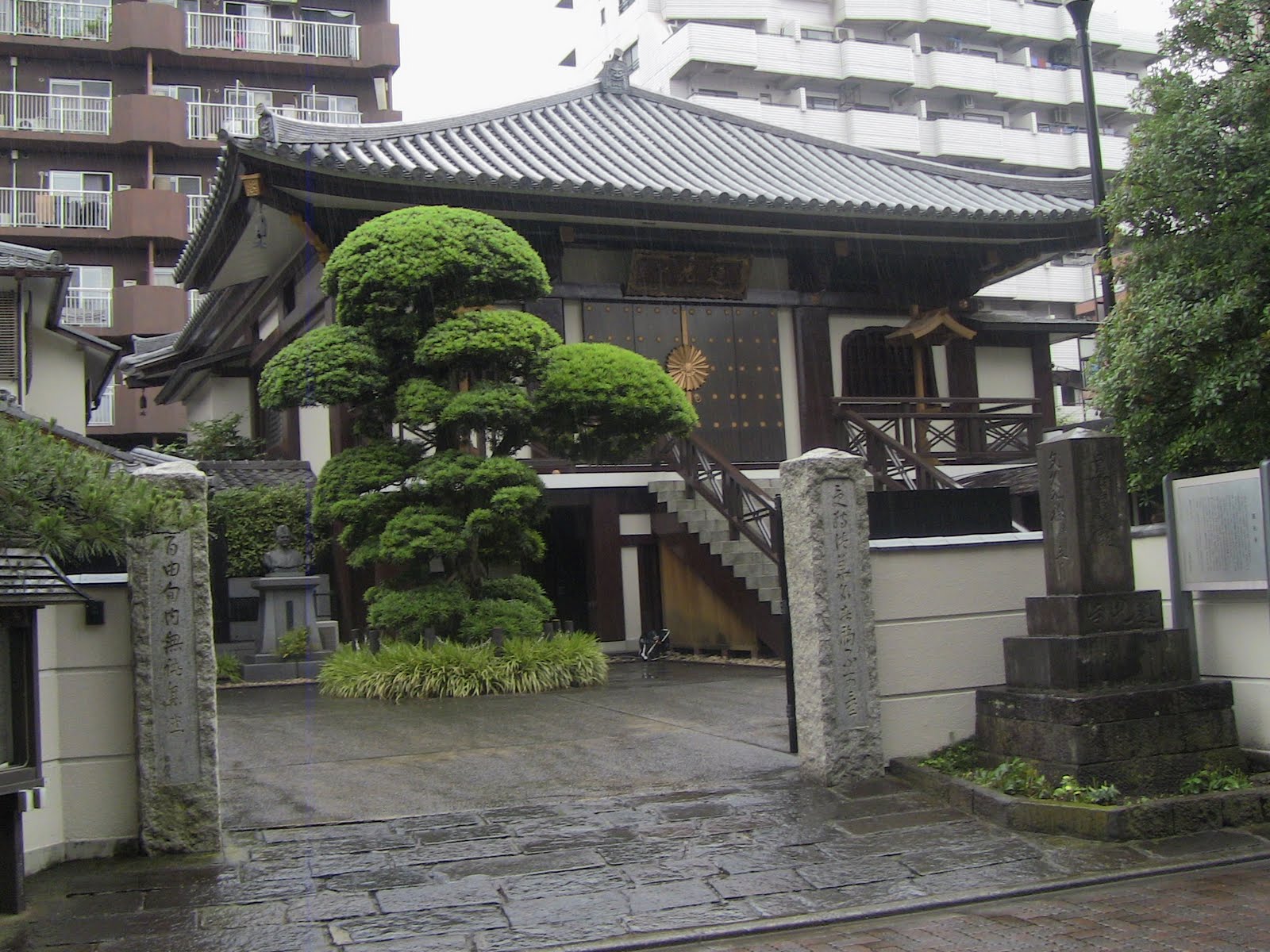
On June 18 we visited the Renkoji temple, where the ashes of Netaji Subhash Chandra Bose is believed to be kept. We have been thinking of making our visit to the temple ever since we heard of such a temple in Japan. It was a surprise to us to hear that Netaji is being respected in Japan, far away from his own country.


Netaji was a revolutionary freedom fighter who has a special place in the hearts of the youth in India. Though the history books in India have limitations in teaching about Netaji and his principles, people respect him as the most influential personality who could contribute the most to the Indian freedom fighting. He was the first to call Gandhiji as Mahatma. Mahatma in Hindi means the great soul. Due to the differences in approaches and opinions towards the methods adopted for India’s freedom movement with Indian National Congress, Netaji left India to seek possible help from other global partners like Germany and Japan. He succeeded to get the help from the then emperor of Japan during second world war and formed Indian National Army, INA by gathering Indians settled in Malaysia, Singapore and similar neighboring countries. Many Indians from the British India also joined in INA to fight against British East India Company rule.

Sunday, April 24, 2011

Marriage has many pains, but celibacy has no pleasures

An interesting topic came out during discussion with friends recently was the right age for marriage. The discussion on this topic was particularly useful as it added more Japanese vocabularies that are associated with the culture and daily life. The first word learned was Tekireiki written in Hiragana as てきれいきand in Kanji as適齢期.

The old concepts of marriage and the right age for marriage might have changed or deviated in Japanese society. The concept of appropriate marriage age differs from country to country and even within the country intself. In India for example, where multiple races, multiple religions and multiple customs are being practiced, the concept of marriage age is not uniform. While it may be difficult or practically impossible to find an average age for marriage age in any country, it is possible to find the average trend in any society.

Sunday, April 03, 2011

Ganbare Nippon!

The immigration officer at Chennai Airport asked me whether it is safe to go to Tokyo now. I told the situation is getting improved. That might be what anybody could have said on 26th March. Things were uncertain when started to Tokyo. Uncertainty prevails even now to a ceratin extent. Today’s live radiation levels in Tokyo showed a higher value, but still well below the permitted safety levels.

More than three weeks from now, the disaster had shaken the world’s second strongest economy. The fear of nuclear radiation has not gone and an uncertainty prevails all over. The Japanese televisions presents the actual facts on a daily basis. There is bilingual service available in NHK that helps foreigners to understand the situations in Japan.

Looking back three weeks, it is a  pure coincidence that we planned our vacation on 11th March to leave to India to perform my father’s 10th annual death anniversary rituals. With kids we left Tokyo at 11:00 AM on 11th March. We heard the news after landing at Chennai Airport and by seeing the scenes at the hotel television we were literally terrified. With teary eyes, we went to bed. Next day, while traveling on domestic flight to Kochi, we could read the headlines on a leading Malayalam daily about the earth quake and tsunami in Eastern Japan. The heading conveyed the magnitude of the tragedy happened in Japan, the country we left hours before. We could read the heading as ‘Japan was swallowed by tsunami’.

Sunday, January 16, 2011

A unique way of teaching Japanese language to foreigners


It seems as if the thermometers in Japan recently are reluctant to rise more than 10deg C. Yesterday the iGoogle weather gadget was showing -1 deg C at midnight and as per the reports on Sunday a cold air wave is supposed to hit Japan that will lead to low temperatures. It has been snowing at the surrounding prefectures of Tokyo. Tokyo remained at low temperatures with cold wind at times.

Recently, I used to watch the weather reports in NHK after I learned the basic words and phrases being used in a weather report from Mana Suzuki-Sensei. Ever since there were reports of cold air wave thwarted the life in Europe and Northern America , Japan was also expecting similar climatic pattern this year. Japan Meteorological Agency had warned of strong winds and heavy snow and high waves, specially along the coast of the Sea of Japan that will continue through Monday. As per the weather reports a strong cold air mass and freezing cold pattern continues to stay around Japan.

From the third week of December and after the Japanese language proficiency test, Mana Suzuki-Sensei changed the style of teaching Japanese language from the conventional way of following a book. I experience her way of teaching Japanese very useful when students get many chances to hear and practice daily life conversations. It is almost impossible for fresh foreigners to follow announcements at public places and also words used at public places in day to day life in Japan.

Monday, January 10, 2011

New Year celebrations in Japan

Before the chirping birds liven up the eastern horizon, we walked out to the chilling cold. Literally shivering in the chilling cold, yet with the single-minded resolution, we walked on Funabori-bridge that crosses the river Arakawa. The temperature was around 2 deg C. The wacky herd of seven was proceeding to the middle of Funabori-bridge to say nothing but a ‘Happy New Year’ to Arakawa River.

A New Year celebration without this ritual would have been meaningless. Arakawa River symbolizes to the whole Japan and neglecting the winter morning cold wind, we could say Happy New Year to the whole Japan. This is how we started the first day of 2011.

This year’s New Year party celebration was unique and standout with memorable events. In the past I had participated in New Year celebrations at Riyadh, Goa, Gurgaon and Chennai apart from the hometown Thrissur. This year, the celebrations started at 31st evening and continued the whole night till 2011 January 1st morning with exciting amusements. The final crazy ritual, i.e., to say loud happy New Year to Arakawa river in the morning cold was directed by Uday-san, popularly known as Neelan among friends in Japan.

New Year is celebrated in Japan in a big way unlike many other East Asian countries. The Japanese people follow Gregorian calendar and celebrate New Year's Day on January 1st the same way as Europe and America do. Though different cultures have different concepts and period for celebrating their own specific New Year day, January 1st has become an international New Year day. History says Japan was following Chinese lunar Calendar till the year 1873. I think Korea, Taiwan and Vietnam are still following Chinese calendar. Japan adopted Western style to celebrate New Year on January 1st with the acceptance of Gregorian calendar after some years of the famous Meiji Restoration.

Japanese people celebrate New Year with their own unique customs. There is a belief that if the New Year events are not done properly the rest of the year will be ill-fortune. There is a spirit for New Year also. It is called ‘Spirit of New Year’ and in Japanese 年の神 (としのかみ-toshi no kami). Spirit is Kami in Japanese language. Houses and business places are decorated with Kadomatsu (門松―かどまつ). Kadomatsu is made of bamboo and branches of pine branches. I could read more on the festivals in Japan from the notes given by Seki-sensei. Also, recently I encountered Kazumi-sensei’s blog that teaches Japanese language and customs using English and Japanese. Kazumi-sensei’s recent post has a photo of Kadomatsu. When we went to Oshiage to see the Tokyo sky tree yesterday, I could take photo of Kadomatsu that was displayed in front of a Japanese restaurant.


I used to receive New Year greeting cards from my colleagues for the past years. This is a custom in Japan to send post cards to friends and relatives similar to western culture. In India too people send greeting cards to friends and relatives. With the growth of internet, e-cards are popular recently. New Year day post card is known as nengajoo年賀状 (ねんがじょう).

The New Year cards were there in the post box on first day of January itself! New Year cards arrive on first day of the year and thereby convey the spirit and warmth of the sender to the receiver. This year I received a New Year card from Mana-Suzuki Sensei, who is my Japanese sensei on Sundays. Sensei gave two gift cards too. It is also a custom in Japan to return or reciprocate equally for any kind of favors one received from another person. I can use those gift cards from the nearby convenient store (Konbini – コンビニ) to buy things.


Though Japanese adopted Gregorian calendar and celebrate New Year on January 1st similar to the western cultures, the customs and rituals are purely Japanese. This is point Japan differs from other countries. My observation is that Japan adopts things from other countries and soon converts them to a unique Japanese style.

Once something is accepted to Japanese style, it is very hard to identify it as foreign again, similar to the process happened to the word ‘convenient store’. The word ‘Convenient store’ is adopted to Japanese language as Konbini and foreigners without any introduction to Japanese language can never guess any of the similar English word like Konbini. New year celebration and customs in Japan too are best examples of this typical Japanese adoption process. Such an indigenous conversion happens in Japan and this is one of the distinct characteristics of Japanese culture.
My Experience with POVO After Leaving Japan - A Caution for Foreign Residents

When I was living in Japan (until May 2023), I used KDDI mobile services for many years without any issues. When I was transferred internall...