Wednesday, June 10, 2009

Japanese language class at Higashi Ojima Bunka Center – Higashi Ojima Nihongo

It was quite difficult for me to write my name in Hiragana when the organizers of Higashi Ojima Nihongo - Japanese class at Higashi Ojima culture center (Higashi Ojima bunka center) told me to fill up the interview form. I could manage to write name, address and other details in Katakana, a little bit of hiragana and some portions of the address in Kanji also.

For some initial months after coming over to Japan, I had an elevated interest to learn Japanese language. That was the time my first nihongo (Japanese) sensei (Teacher) Mr. Kennichi Tabe (Tabe-san) started teaching initial lessons of Japanese along with the classes at OVTA. I found myself enjoyed learning from Tabe-san, though it was an informal way of teaching.

Sometimes we learn more from casual way of teaching than from professional teachers. The Japanese classes at Higashi Ojima culture center is one of such an easy way of learning Japanese. The teachers are volunteers who teach foreign people who are interested to learn Japanese at a nominal fee of 500 Japanese Yen per class.

One class will be around 1 hour 30 minutes. The first lesson is free and is considered as a trial for the students. Being a student at this age is a funny thing. Anyway, life is a continuous process of learning and we are always students in life. Life teaches us many things in due course of its flow. Some people learn fast and some lag behind. That learning process is different from language learning process.

It is a one to one classes, means for one student there is a teacher. It is convenient to learn from the teacher as he/she is fully available for the total class hours. Though a bit informal, I enjoyed the first day of learning from Higashi Ojima culture center Japanese language class. There were around 12 students, some of them are quite older than me!

When my colleague, Mr. Remus sim found this new way of learning Japanese language for me, I was little skeptical on the timings. The timing of the classes at Higashi Ojima cultural center is from 7 PM to 8:30 PM. There will be one class in a week. Here in Higashi Ojima, it is on Wednesdays. If there are five Wednesdays in a month, the last Wednesday will be a holiday. Totally, there will be four classes in a month.

Language learning is more a personal effort than a teacher’s ability for the grown up people. For children, to a great part, it depends on the skill of the teacher also. I did not put much effort for the past many months to learn Japanese language. Learning Japanese will make the life in Japan more comfortable, though it is not really required for the work. For many people working in multinational companies in Japan, Japanese language is not essential. Many of them stay long in Japan and still be able to manage the life only with Ohayo gozaimasu, that also with erred slang.

My colleagues are wonderful friends who have been helping me for every walk of life. They talk on behalf of me sometimes to clarify doubts raised by water and sewage department or electricity departments or sometimes with Yahoo BB. Due to the inability to speak Japanese language, the life in Japan is that of a kind of dependent, but of good friends. I am fortunate to get good friends in Japan including some foreign friends and Japanese friends. Remus found the Japanese classes for me and Iwabuchi-san talked on behalf of me with the organizers of the Japanese language class. After talking with the organizers, she informed me that there is one more Indian national attending the class at Higashi Ojima.

Today’s Japanese lesson was interesting and worth. The Higashi Ojima bunka center is near to the Daiei in Shin Ohashi dori, right after the exit of Higashi Ojima station at Toei Shinjuku line. We have to walk 7 minutes from the station to the bunka center. The classes are at the third floor. After all learning is partial process. Student must invest own interest and effort than the teacher! You need to inform over phone for the first day or contact directly to the class and explain.

Find the map here to reach at the bunka center and attend Higashi Ojima Nihongo

Sunday, May 31, 2009

Thoughts on Japan, society and Japanese people

Walking down the street, we had an interesting discussion with us. How came the Japanese so different from other East Asians? Discussed in many social forums may be thousands of times by veterans, these topics are still alive, but I particularly had nothing new to add to my opinion. Choi bun-san had something new to tell me.

Being from Korea, he knows well that the physical difference between most of the East Asians and Japanese is almost zero, especially with the northern Chinese and Koreans. The looks are similar, but when he says the attitude and behavior is different I had to agree. How can I, better than him be able to differentiate similar looking people. The race is same, the physical appearances are same, but there are still elements that separate Japanese people from others.

The culture, the language, the behavior, the response towards events etc are different. This does not mean that Japanese people are free from all kinds of bad manners or they are extra ordinarily obedient or disciplined. When I say from my own experience that Japan is clean, people are disciplined, law obedient, well-mannered, free from social crimes, I never mean that Japanese society is one hundred percent free from all kinds of dirt, indiscipline, law breakings, ill-manners, anti-social activities etc.

There may be bad people in Japan as it is with any society. There are dirty things, there are unclean areas, there are violations of law and rules, there are aggression in the public places, there are murders, rape, child abuse, there are drunken people shouting in public places, hundreds of cases of anti-social activities reported from Japan and thus goes the list of all bad things in society just the same way like in any other society. Japanese people are not extra-ordinary people in the sense that they are just like the same kind of human race as is with any other human population. Japanese people are extra-ordinary in their attitude to eliminate or free themselves from many of the evils in our societies. That attitude makes the difference. That attitude of Japanese people reflects in their whole education system and social fabric.

It is just that! But this is the great thing with any human population. The attitude and nature of majority of Japanese people are warm, welcome, pleasant and optimistic towards others and their own life. Is it not the same with other east Asians? Are they not warm and pleasant? Of course, Yes. They are also good and their societies are also warm. Just the percent of that elevated class of human beings are more in Japan. This makes the difference and projects Japan in a well frame to the rest of the world.

Choi bun-san had his own versions to justify his observations. I have very few opportunities to know more deep about the real Japanese psyche.

Who is bad and who is right? How can we judge people without any prejudice? When we make standards for measuring or observing or judging other characters, always those standards will be affected by our own views. Then those standards cease to be neutral. In fact, there may not be any neutral standards by which we can measure human beings and their behavior. We are not better judges of anybody.

It is heavily raining outside as I started recollecting the conversations with Choi bun-san. Today’s News paper head lines carry the news of war planes reached from America to Japan.

Japanese society has been peaceful and quiet for many years. The life here is also peaceful and calm. Japanese society is well taught to respect each other and respect strangers. The Bushido culture teaches to respect the enemy too. Historical evidences shows the fighting communities within Japan respected each other in war.

Napoleon Bonaparte, after capturing Russia, decided to return back without touching China. The reason he told to his military was that it is a sleeping monster. Sleeping does not mean weakness. Japan is not weak only because Japanese people love peace.

Thursday, May 21, 2009

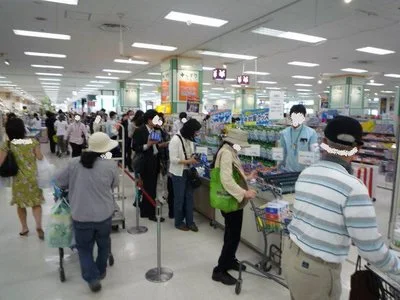
How long a queue can go? – Swine flu and the queue for mask in Japan

Wong-san was desperate that he could not grab a packet of mask when I met him in front of Ito-Yokado. Swine flue is spreading in Japan. The news flash in television and newspapers goes like a wildfire and people are worried about the coming days.

Prevention is better than cure. Precaution against any kind of spreading disease is better than getting it and treating. When the life enters to a certain degree of improbability or uncertainty, we feel insecure. Japan was under a grip of strong sense of security against many kinds of social crimes and spreading diseases. It seems, the life here was going smooth for many years after the World War II. Uncertainty brings panic.

Wearing masks is only a protection, but it is not a prevention of death! Who can prevent the death? Masks are only a hideout from the enemy. If the real enemy is within ourselves who can save us! The immunity system within our body is the one which can safe guard us to some extend from the spreading diseases. Unfortunately it is not developed in one day or just by wearing a mask. After all who can guarantee the life? Can the God guarantee?

Most of the Japanese do not have proper faith in God. It is a kind of atheism that got prevalent dominancy in Japanese society. Gods never saved Japanese people! Fortunately there are not many Gods in Japan. The one who is being worshipped, Buddha, really denied the existence of God by himself in all his teachings.

Instead of standing in long queues in front of a temple, Japanese people would prefer to stand in queue in front of a medical shop or any other shop to grab a packet of mask. Japanese people rarely wear mask if I put their natural habits in a double meaning. But they wear a mask when they get flu or before the start of blossom. Some people are allergic to the pollen grains.

This time it is the swine flu which is terrifying the routine Japanese life. Commuter trains are heavily packed and the chances of getting affected are much easier in public places.

When we went for lunch at Makudonarudo (Mc Donald), Remus-san has taken some photos yesterday. Remus told me to write about this queue with photos. When Remus visited some other places in Tokyo, he saw some shops displaying banners with “Masks sold out” No more masks available etc. Interestingly some shops had more than one banner with the same caption. The shop owner may want to invite the attention of customers looking for masks. Two banners can not be neglected by many of the customers!


Today the queue was much longer in the Ito Yokado. People are really scared of the swine flu in Japan. Mask manufacturers, distributors and shop owners will make good business. They have employed some extra staff for controlling the queue.

Swine flu, God and Mask do have some thing in common as Death, Disease and Pollen grain do have. The only thing remaining mysterious is the queue. How long a queue can go? The queue for mask and the queue for swine flu – both are competing for the length of queue. The queue for God is getting shorter day by day.

Swine flu is called and influenza in Japan. The pig fever is not a favored one. Probably Japan is one of the biggest markets for pig meat. The swine flu was brought to Japan by some of the students returned back after visiting Canada. Now Japan is the fourth worst swine flu affected country.

The spread of swine flu is not good for anybody for sure and the harm it does to the Japanese society will be much deeper as is it with any other country. The sale of masks has gone high upto 30 percent since the news of swine flu in Japan. The goruden uiku (Golden week) holiday tours are also negatively affected due to swine flu.

Pigs can really do much harm to human beings than we think! Did we underestimate the pigs? They are not just pigs. They also stand in queue in the slaughter house. The life for them is also uncertain when they stand in the queue waiting for their turn to be butchered. It is that uncertainty from their mind spreading to human beings now. Darwin smiles sarcastically.

Sunday, May 17, 2009

365 days of blogging life in Japan

If time, hours, day, months and years have something to do with human life, today is one of such important day in my life. May 17 had witnessed important events in the life earlier also. I don’t believe in celebrating my birthdays, but when it comes to notify my friends that it was on May 17 last year I started this blog, I should not hesitate to do so.

Yes, today is the 1st Anniversary of this blog. My life in Japan is one year old today!

Dear Blogger friends, your valuable suggestions and comments are anticipated. Thanks in advance.

Day and night, as written by Hawking, may probably be a relative phenomenon depending on the position of the observer. Though observed from within the mind, it was not so long ago that this blog started appearing in the google searches. The land of rising sun has ignited enough thoughts at the hearth of the mind.

While commute on buses and trains, the observer within was silently witnessing the activities outside. The observer inside was restless to learn new things when talking with Japanese people of different nature, while interacting with them and while reading through the culture of Japan and the society. It was this restless learning of new things in Japan that formed the reason for the birth of this blog.

Blogs does not happen automatically, but happens out of a restless desire to express own feelings and opinions, to share the new knowledge we learn in life, to find out a vent for nasty emotions generated out of the unpleasant experiences from all corners of life.

This blog on my life in Japan was a product of such restless mind and disorder. The disorder, not only in the society, but also within, urges for order on everything comes in contact. This blog did not happen out of sudden spurt of emotions in favor or against anybody, but happened out of a strong desire to tell the world outside thorough what I have been going through in Japan. The world outside including my relatives and friends responded equally well since the birth of this blog.

Today is the 365th day of blogging life in Japan. Google provided a blogging platform where I stand and share with the rest of the world what I have been experiencing in Japan. Thanks to all those who have been visiting this blog. Special thanks to Manisha and Anima for following this blog. I have learned many new things from their blogs.
Have a nice day to all readers!


Signing off ..........

Best Regards
Jayaprakash
May 17, 2009

Katakana writing system in Japanese and interesting pronunciation of English words

One of my friends Tom-san do not like the Katakana. The reason she tells is very simple – why Japanese people change the English? She likes Hiragana. For me too Katakana looked awry at first, confusing till now.

When Morishita sensei started teaching Katakana characters at OVTA, Kahin Makuhari, we were telling jokingly that we will forget the hiragana characters that we learned earlier. That was true to some extent. We felt difficulty in recognizing hiragana characters when katakana characters started occupying the brain!

For the same pronunciation of Hiragana characters, there are equivalent katakana characters. This means Katakana and Hiragana are two parallel systems of writing same sounds. Hiragana is used to write words of indigenous origin, while Katakana is used to write Foreign words.

Identifying a foreign word is thus easier in Japanese language. Hiragana in combination with Kanji makes all the indigenous words in Japan and Katakana stands for foreigners!

The trouble is recognizing the foreign word once it is written in Katakana. It is really a mind boggling experience for many foreigners or at least for me! I take a bit time even to read my name written in Katakana. In Katakana, my name will be twisted as ‘Ja-ya-pu-ra-ka-sho’. Fortunately my name is not much twisted and can be easily recovered back to its original shape.

There are certain words in English that Japanese people use and write in Katakana, reading and recognizing which for many foreigners is a brain teasing game. One such word for me is goruden viku. When I encountered this word last year for the first time in a product advertisement caption, I thought of it for quite some time and then started guessing by connecting it with English words. I related all the coming events in the near future in the attempt to retrieve the Japanized foreign word. Finally I recognized it as ‘Golden week’.

Ra-ji-o is another word that cracked my brain. The funny word ever I heard is ‘Kombini’. It was very funny to hear from our Morishita sensei about the Kombini. Kombinis are really Kombini in Japan. She told about the shortening of long word to smaller ones by Japanese people. Then I remembered the manufacturing concept of Japan to make things smaller. Small is beautiful in Japan. So is what happened to the Kombini. Kombini is the shortened for of ‘Convenient store’ used by Japanese people. Morishita sensei said jokingly that Kombini is her kitchen.

I was also depending on Kombini for food till April of this year. In Japan, convenient stores, particularly the a.m p.m are opened for 24 hours. They are called as ‘am pm’ also and are really helpful to bachelors in Japan.

Hoto kohee (hot coffee) is the one I prefer to drink at Maku donarudo (Mc Donald). After lunch we go to the second floor by Esukareta- (Escalator), though there are Erebe-ta- (elevator). At the second floor of Ito Yokado, there are sutoa (store) of Terebi (TV), pasokon (personal computer) and other electronic items as well as some resutoran (Restaurant). Down stairs have stalls for Nekutai (Neck tie), puresento (present, gift) and have a supa (super market). During December, there will be special sales for Kurisumasu keki (Christmas cake). Items from Supain (spain), Itaria (Italy) etc are also available in the shops.

Why Japanese writing system modifies the foreign words. The answer is simple. Japanese language has simple pronunciation based on 5 different accents. They are;

A (sounds like ‘a’ of a ‘cat’ and the ‘u’ in ‘put’)
E (sounds like ‘pet’, ‘set’, ‘get’ etc.)
I (sounds like ee in ‘keen’ or ‘see’ but somewhere shorten like ‘sit’
O (sounds like the one between ‘taught’ and ‘pot’
U (sounds like the u in ‘put’ but the mouth corners may pull back a bit)


It seems, the Japanese people fit all the words in to the five sounds. Certainly there are many other sounds in foreign languages. In order to write them and fit them to readable and writable in Japanese language, the foreign words must be twisted and forged to make it Japanese! Thus the Japanized version of foreign words becomes very funny to foreigners.

A cake might be tasty to everyone, but how about if some Japanese ask you if you want to eat a keki?

My Experience with POVO After Leaving Japan - A Caution for Foreign Residents

When I was living in Japan (until May 2023), I used KDDI mobile services for many years without any issues. When I was transferred internall...