Thursday, August 07, 2014

What If I Were A Muslim?

A memory from 2013 recently resurfaced in my mind, one that still makes me pause and reflect on human behavior. I was in transit at Hong Kong airport, coming from Dubai with Tokyo as my final destination. The airport was undergoing renovations, and I felt a bit disoriented while navigating the corridors toward my gate.

As I walked, a woman in a professional suit gently called me over from a corner, joined shortly by a man. It quickly became clear—they were immigration officers on special duty. I prepared myself for questions, as I had faced similar encounters many times before.

The exchange went something like this:

  • Woman: Where are you from?

  • Me: India

  • Woman: No, I mean where you are coming from now?

  • Me: Dubai, for a business meeting

  • Man: Where are you going?

  • Me: Tokyo

  • Woman: Do you live in Japan?

  • Me: Yes

  • Man: Where is your family?

  • Me: They are also in Japan

  • Man: Do you have a Japanese identity card?

  • Me: Yes (handed over my Alien Registration Card)

  • Man: Please show your passport.

  • Man: What is your name?

  • Me: Jayaprakash (full name as in passport)

  • Man (curiously): So, you are not a Muslim?

  • Me: No

After this, he handed back my passport with a smile and wished me a pleasant journey. Throughout the encounter, both officers were polite, gentle, and occasionally smiled to ease the situation. I remained calm, careful not to escalate or show frustration—it’s part of their job, after all.

But as I walked to my gate, a thought struck me: what would have happened if I were Muslim? I didn’t dwell on it long; speculation rarely ends well. Yet, the question lingered.

This memory resurfaced because of a story from an Egyptian friend. He is a general manager of a U.S.-based company in Japan and travels frequently to the U.S. Every time he lands, he is sent to a separate room for questioning. The same officer handles him each time, recognizing him well—but there is no concession. The reason, he believes, is that his name signals a certain religious identity.

These incidents illustrate something subtle but powerful: bias exists everywhere. It might be based on religion, nationality, skin color, or other markers. Sometimes it’s unconscious, sometimes institutional. Denying it is easy and common—but acknowledgment is far more constructive than denial or dismissal.

Bias is part of human nature. What matters is how we recognize it, reflect on it, and ensure it doesn’t dictate our actions or cloud our judgment.

Monday, April 28, 2014

A Fresh and Rejuvenating Restart

Fresh and Rejuvenating restart for my life in Japan
For quite a long time, I could not update this blog. Still I used to receive some comments on the blog. I tried to reply to some of them, but admit my failure for majority of the comments. Interestingly almost 90 percent of the comments are in "Cost of living in Tokyo for a foreigner"

I realized the importance of this blog when I was away from here for almost two years. You may wonder why? This is the sixth anniversary of this blog. I started writing this blog just for fun at first and then went curious to learn 'the new platform' from where I could address. Over the past six years (including the two years of absence) I learned that the posts I wrote here were useful to many people.

Many of the visitors to this blog asked for vital information to frame their life changing decision. There may be some online resources for getting general information about Japan and the cost of living. The prime purpose of starting this blog six years before was not to write about the cost of living in Tokyo. One of my friends in Singapore asked me the details of expenses in Tokyo for her article in a magazine. After sending the details to her, I thought of sharing excerpts of that content in this blog. Somehow the search engines brought many visitors to this post.

There may be other online resources for cost of living in Tokyo. Nature of expenditures for a foreigner is different from that of a Japanese national living here. It is quite natural for people who get job in Japanese companies to go curious about Japan and the cost of living. People are eager to get some useful information, especially when they are far away from the place where they have to go and make a living. Though, there aren't any obligations, there may be a factor of social commitment to each individual to be useful with one's neighbors. In an online social platform such as this blog, every visitor is close at the length of a hand that we can feel his presence in front of our eyes.

This prompts me to restart this blog. I don't make any commitments. This blog was born on a golden week. This is the sixth golden week since then. This is the spring season and once again the nature outside has robed herself in floral dresses. The air is fresh and rejuvenating and I feel this is a good time for a restart.


Friday, March 21, 2014

Shunbun-no-hi, the Day People Offer Food to the Departed Souls

The spring starts from today. The morning sun was bright when I woke up at 6 in the morning. When going to bed yesterday, I was prepared to sleep until 9 in the morning, but in the middle, I got a phone call from Google (unknown caller), and he introduced himself as “David”, who was assigned to assist me to solve the domain registration issues. David told him he will call at 7 in the morning. I had to wake up early, though today is a national holiday in Japan.

People celebrate the start of the spring season, the name of which in Japanese is Shunbun-no-hi. On Friday, one of my colleagues told me he will go to stay with his parents since we have holidays for 3 consecutive days. Shunbun-no-hi was actually yesterday, that is, on Sunday, the 20th of March (yesterday). When the national holiday falls on Sunday, the holiday will be shifted to the next day. That was the reason we got the 3-day-long holiday, which is called Sanrenkyu. The day and night would be equal today. It is surprising that our ancestors possessed the knowledge of celestial movements and watched the nature closely. Shunbun-no-hi is the Spring Equinox. The Autumn Equinox will be in September. There would be noticeable differences in weather from today.

While waiting for David’s call, I searched for Shunbun-no-hi. It is believed that the Emperor of Japan enforced the celebration of the spring equinox in the eighth century. Shunbun-no-hi is only one day, but the tradition is to observe seven days of rituals, three days before and three days after the Shunbun-no-hi. This period is called Haru no higan. Shunbun-no-hi usually falls on March 20 or 21 but could be between 19 and 22. The exact date of the Shunbun-no-hi holiday next year will be decided after February of the current year. Some types of Sakura trees start blooming during this period.

Cherry blossom pictures in JapanSpring starts after the Shunbun-no-hi, and the weather becomes warmer. In other words, this period marks the end of the winter season. The tradition of observing the Haru-no-higan originated from Buddhist beliefs. Higan means another world. When the day and night become equal in length, Buddha appears on earth to guide the stray souls to the path of nirvana.

My colleague didn’t know the history of the Vernal equinox. When asked, he told us his parents used to offer botamochi (red bean paste-covered rice balls) to the ancestors. Ancestors would consume this food and proceed with their journey to the next world. Giving food to the departed souls and helping them to make their way in their eternal journey is a great belief and ritual. We also have a similar custom of offering food to the ancestors. Around this same period, we celebrate Holi, the festival of colors in India. 

“Shunbun-no-hi” is written in Japanese as 春分の日. The kanji 春 can be read as Shun and Haru. This kanji is used to write “spring.”. After attending the call from David, I became curious to know more about Shunbun-no-hi (a thing that never happened in the past 8 years). The Shunbun-no-hi becoming a holiday in Japan was not long ago. It was in 1948 when the United States decided to rewrite the constitution and separate Shinto religious practices from state affairs.

Years ago, this holiday was known as Higan no Nakaba, the translation of which is “Middle of the Equinoctial Week.”  Many people, including my colleague, might have forgotten the history of Shunbun-no-hi. Many of them know it as a public holiday. For foreigners like me, this day marks the start of spring in Japan. Sakura flowers will start blooming all around, and the climate will be pleasant.

Tuesday, March 12, 2013

Memories of a Traumatic Disaster

Today is March 11. It was exactly two years ago that a deadly tsunami hit the northern prefectures of Japan and devastated the peaceful life of many residents. The subsequent aftershocks and the whole Fukushima episode had literally frightened and placed people in Japan at high levels of uncertainty. That was the height of uncertainty and insecurity we had ever faced in Japan.

It was a surprising coincidence that we left Tokyo on March 11, 2011, at 10:30 am for an annual vacation to our native place. When we landed at Chennai Airport to catch the connecting flight to Kochi, the immigration officers asked us how quickly we could evacuate Tokyo! It was to their surprise when we said that our travel plan was just coincidence. After reaching home and switching ON the TV, there was not even a glimpse of hope of Japan returning to normal life in the nearest future. Since we knew the spirit of Japanese people, we were sure about the recovery of Japan from that disaster in a short time.

By keeping away all skepticism, when we decided to return back to Japan on 28 March (as planned when we initially booked the tickets), I had a difficult time convincing relatives. Two years have passed now. Japan is still the old Japan. The disaster could have stopped Japan for a while, but the wheels of reconstruction had already started moving.

After returning to Tokyo in 2011, we were a bit concerned about rumors spreading about the radiation levels. All Japanese TV channels were showing efforts of Tokyo Electric Company to contain the damaged nuclear reactor in Fukushima.

Online media and social forums were filled with discussions on the radiation levels and precautions to protect from radiation effects. Some people became concerned and started declining vegetables and grains from Northern prefectures of Japan. Some locals even drove to Nagoya on weekends to bring drinking water. Volunteers, both locals and foreigners, were actively involved in the process of cleaning the houses and constructing temporary houses. National Television group NHK was showing the progress of the removal of the debris from the disaster-hit regions.


One of the touching scenes that still haunts in my brain is that of a man who was searching for his relatives in the debris of his house destroyed by the deadly tsunami. When asked by the NHK TV reporter until when he would continue his search, he told with a trembling voice: "mitsukerumade" (見つけるまで), literally meaning: "Till I find." 

That was a time I could not control tears dropping out of my eyes. I realized a pain in my heart. That day I cried a lot like a child, and I did not consciously try to stop crying. His face and his words surface in my mind every time I read about a tsunami or earthquake.

Mitsukerumade, Yes, 'Till I find.' That is the spirit running in Japanese blood.

Tuesday, May 22, 2012

Solar eclipse in Tokyo – a rare celestial meeting

From our balcony it was clearly visible – the celestial meeting that occurred after 173 years in Tokyo – the solar eclipse. For kids it was a wonderful experience; they were as happy as if the sun, moon, and earth came out of their textbooks.

It seems that many people in Japan prepared themselves to watch this rare eclipse that started early in the morning. As per newspaper reports, it started at 6 in the morning, but the moon’s travel to the sun’s center started at around 7:29 AM.

The sky was cloudy, but the sun was bright and powerful as usual on a summer morning. After 7 o'clock, shadows of clouds started becoming darker, giving a feeling that it might rain at any moment. We woke children up from sleeping to show the rare celestial event. The school had announced a two-hour late opening, but Japanese schools were working as usual.

Tuesday, May 08, 2012

Regain Waning Romance in Koishikawa Korakuen Garden


26 minutes by train, Koishikawa Korakuen Garden was the easily accessible garden from our place, not yet visited, found appealing and recommended by many visitors. When we reached, the climate was good. The day was not recommended for an outing since rain was on schedule in the afternoon.

Koishikawa Korakuen Garden is near the Iidabashi station along the Oedo line. This is the nearest train station. If we take the Iidabashi station of the Tozai line, we need to walk a bit and cross an overbridge to reach the garden. From Oedo line Iidabashi station, it takes around 3 minutes, and from Tozai line, it takes more than 8 minutes by walk. The JR Sobu line also has a stop at Iidabashi and takes around 8 minutes to reach the garden.

Monday, December 19, 2011

Programming the crowd by conditioned reflexes


There was an interesting sharing yesterday by one my friends in facebook. The shared post was a slide showing the result of an experiment by scientists carried out on a group of monkeys. The outcome of the experiment is interesting and has significant importance to our social behavior, the reason why I would like to write here.

At first the scientists selected a group of 5 monkeys and put them in a cage. In the middle of the cage they placed a ladder. At the top of the ladder, they placed some bananas. Obviously, the monkeys will be tempted to eat the bananas. One of the monkeys climbed up the ladder and took the banana. Then the scientists splashed cold water on other four monkeys standing on the ground. Splashing of water was repeated whenever a monkey climbed and took the banana. The monkeys now realized that whenever a monkey climbs the ladder, the rest will be splashed with cold water, which they did not like.
All the five monkeys one by one tried to climb to take the banana, but the one who try to climb would be punished by beating by other four monkeys.

As a next step, scientists replaced one of the monkeys with a new monkey. The new one’s mind was fresh and did not know about the cold water splashing. By seeing the banana he started climbing up. The other four got angry, pulled him down and beat him. Scientists did not splash the cold water, but the fresh one got beaten by others.

Thursday, December 15, 2011

What Makes Japanese People Different from Others?

Every time I read about the street fights and hooligan hostilities in my country, I am more convinced that we are still at the primitive stage of human civilizations, though it is widely thought otherwise. The motivation to start writing this post is Mr. Omar Abdullah’s tweet on the hospital fire in Kolkata, one of the famous cities in West Bengal. While our history books are proud to acclaim thousands of years of inherited civilizations, the anarchic state and the vicious uproars point to the story of an immature and halfway dropped civilization process in India.

We may have hundreds of reasons to justify the hooliganisms and vandalisms, sweetly coated with the reasons of freedom of speech and expression, democratic rights, and so on. Freedom of speech and expression should not harm others as well. Those actions that harm others cannot be counted as the result of a democratic way of agitation. Such criminal actions are the result of the desire to kill, the desire to destroy, and the animal instincts that exist in the primitive minds of human beings inherited from their uncivilized ancestors.

People in southern states of India, one state which is home to the most educated people and the other which is home to the cultural capital of India, have been misled by their political protagonists. It is hard to find ‘differences between people in Tamil Nadu and Kerala’ unless you are strongly motivated to write a thesis on that subject. The problem could have been solved through discussions rather than pulled out to the streets. The street dogs know only to fight and bark for a single piece of bone, and this is what we see and hear now. An illiterate crowd could be malleable, but one thing has become certain: now that education, or the rate of high literacy, won’t automatically bring any common sense or guarantee that the educated mass cannot be mass-hypnotized.

Is this what we had inherited from our ancestors through the so-called 5000 years of ancient Indian civilizations? The land where the looking into the self was taught as more important than looking to others had gone years back to the early stages of human development or might have stopped somewhere in the middle of the civilization process.

The chaotic state still exists in India, where multiple ethnic groups have to share common land and bread. The migration of ethnic groups and their spread were not directed with a clear objective; rather, the movements might have been caused by war, famine, and natural calamities. The intrusion of new elements into an existing system causes disorder. Disorder causes for collision. This is true in the science, and now I am convinced that it is true in social science too.

In fact, collision is what we see in our society. As the particles collide and generate heat in a system, different groups ram, and we call it unrest or agitation. This process may continue till a unification happens, and it may take years, but any society where multiple interest groups co-exists has to go through these processes.

Japan is almost homogenous and has one of the highest rates of literacy. Four years before, I read in a blog that the Japanese race is unique. I started searching for the truth of this statement and went through different academic papers and websites. There is no race called the ‘Japanese race.’. Japanese people belong to the Mongoloid race, in which the Koreans, Chinese, and other East Asian people belong. The other way around is propaganda that is similar to the one that Indian right-wing groups use to find a common ancestry for all Indians by denying outside migration to India. Scientific facts are bad for many deceptive groups.

What makes Japanese people different from other East Asian countries is their more civilized manners. That is the outcome of years of civilization processes that happened in a unique way that is exclusive to Japan. Here I don’t claim any superiority to the Japanese society, and they don’t have it either. They are just like any other country’s people with all kinds of emotions and instincts. History may have something different to tell, but observing the current practices, I feel this way. It is my personal observation that the public behavior of Japanese people, at least among themselves, if not to all the foreigners, is more refined.

There were internal fights in Japan, and there were different interest groups as there are there in other parts of the world. Japan is like a bottle into which differently colored solutions are poured, closed with the cap, shaken thoroughly, and then allowed to rest for 250 years. Now the mixture has become perfect and looks as if it is one of the unique base colors. That mixing produced a different color that is unique to Japan! Want to call it a different race? OK...

Signing off...

Tuesday, December 13, 2011

Japanese way of redesigning the nature and its resources


God (not in the institutionalized form but in an absolute sense) might have His own plans, but human beings have their own plans. Both may not necessarily be the same. When it contradicts there is a conflict, which may result in catastrophes. We call them man-made disasters.

Some fifteen years before while going through a magazine article captioned ‘Future wars will be for water” I was prompted to think to redesign the natural resources so that such conflicts could be reduced. Thoughts of redesigning the natural water resources had its seed from the news on diverting the rivers through the water-scarce regions of Rajasthan state in India. India’s ever powerful lady prime minister Mrs. Indira Gandhi was ruling at that time. She had a great vision to redesign India and redefine the life. She did many attempts to achieve those goals, which the predecessors could not carry forward.

The reason why I started writing this post is not the current fight between two southern states in India for water which is in the headlines of Indian newspapers recently. While walking from Indian School in Nishi Ojima to our apartment at Higashi Ojima by the river side, we could see some construction work in progress on the river banks. Also I heard from Japanese teacher that the kyu-nakagawa river, which is visible from our apartment’s front side veranda is an artificial branch of the Arakawa river.


Thursday, December 08, 2011

What percentage of the salary a foreigner can save in Japan?

 
Some of the visitors to this blog were interested to know the living expenses in Japan and how much they can save. It is quite natural to have these concerns about living costs before one makes final decision to come to Japan. For expatriates, apart from the job satisfaction, savings is one of the major driving forces to accept the offer from their prospective employer in Japan. Cost of living has increased recently. “Especially in the changed scenario” one would like to add with the preceding sentence in the wake of recent alarming news from one of the famous baby food producers.

Living cost for foreigners in Japan and I believe also for Japanese people has been on the rise after March. Either people buy water from the stores. Some book online from western sides of Japan or water from outside Japan. The consumption tax will have negative impact on the potential savings.
 

Friday, December 02, 2011

Disaster is a fact, so is life and death


Some weeks back, along with friends I conducted some measurements to verify the radiation levels at different locations of Komatsugawa, especially where our children frequently play on weekends. Almost 9 months have passed since the disaster, still the fear of radiation linger in the minds of those who decided to stay back in Japan. Radiation is a fact and living with the painful facts needs an extra effort and justification. Probably the measurements we conducted were also to justify our decision to stay back.

It is also a fact that, solving disasters whether manmade or natural takes long time. Any kind of disaster is a sudden transition from a balanced state to an unbalanced state, where the whole system knowingly or unknowingly goes out of a defined set of procedures. Unfortunate, but it happens. It happened in Russia, now in Japan, tomorrow somewhere else. But the thirst of human beings to experiment with their own life to find new things and progress never ceases. It is this aggression of human beings to explore and conquer nature and universe differentiates them from other creatures.

Emotion does not play a significant role in the human endeavors for scientific progression. That is how humans evolved and learned to master things around them. Strong determination to tame the nature and surrounding things in the struggle for existence (more close to the definitions of Ayn Rand than Darwin) is the foundation of modern civilizations.

Wednesday, November 30, 2011

Providing education is not a business at India International School in Japan


This is the second post about India International School in Japan (IISJ) in this blog. The first post was before more than two and a half years after a visit to the school when my elder daughter joined the kindergarten. Now the reason behind this post is the queries raised by some of the visitors to this blog through blog comments and personal e-mails.

I have received both good and bad comments about the school. Some commentators were rude to scold me for writing good things about the school. In that post I tried to see the good things of the school. I don’t really want to reply to those negative comments received earlier since reply to a negative thing will also be a negative thing.

One thing we need to realize is the availability of such a facility in a far away land for Indian children. The approximate number of Indians in Japan may come around 27,000. Most of them are bachelors. Those with children were facing problem due to lack of schools based on Indian syllabus. Most of the Indian professionals stay in Japan for a shorter period and they need to return to the country. Continuing education in India, once they return back was solved by the presence of Indian schools in Tokyo. Indians living in other parts of Japan does not have this opportunity.

Tuesday, October 04, 2011

Ropeway trip from Nihondaira to Kunozan Toshogu Shrine

One of the possible options to reach at the Toshogu shrine dedicated to the Tokugawa Ieyasu, the great emperor of Japan, is to ride a bus from JR Shizuoka station to the Kunozan Yamashita. As the name indicates, Kunozan yamashita bus stop is at the bottom of the hill Kunozan. From the bottom of the hill, 1159 steps goes to the shrine at the top of the hill. That would have been more adventurous, but it might be a too difficult task for children. Moreover, the aerial ropeway ride would be more exciting to the children.

Frequency of buses are not so good from JR Shizuoka station to the Nihondaira hill top from where the ropeway starts. As per the instruction from the tourist information center located near to the ticket gate of JR Shinkansen line, we boarded the bus at 9:27 AM. The bus fare is 550 Yen per adult. The bus fare can be paid inside the bus before getting down. Even if you don't know how to pay, the driver will help.

The bus journey takes around 35 minutes from JR Shizuoka station to the Nihondaira ropeway iriguchi (entrance station). There is a zoo in between JR Shizuoka station and Nihondaira hill top with approx. 800 varieties of animals. If time permits it is worth to get down and visit the zoo. We could see the entrance of Nihondaira gakuin university on the way to the hill. The road to the hill top is with many curves and zig-zag. Persons with trouble of vomiting during travel has to take care by keeping a towel or anti-vomit medications during the bus ride.

Sunday, August 21, 2011

The exotic beaches and the warm hospitality of Japanese people at Shimizu

It was around 3:00 PM when we reached at the JR Shimizu station JR Shimizu station is approximately ten minutes journey from JR Shizuoka station on the way towards Hamamatsu in the JR line and is the third station from JR Shizuoka.

We were little confused after coming out of the ticket gate on the exit that goes to Kashi no-chi market, which is a fish market. After trying to locate the road by ourselves, we decided to approach some one local standing in the bus stop. He guided us to the west exit of JR Shimizu station by coming with us so that he might have thought the foreigners should not waste time again from enjoying the scenic beauty of his place.

We got down through the elevator to the ground and walked 5 minutes to reach to the Kashi-no-uchi fish market. As per our plan made after researching on the internet, we were supposed to find a water-bus service behind the fish market. Since we could not find it by ourselves, we asked an old woman standing in front of the fish market. Since she was not sure of the timings of the water bus that goes from the behind of Kashi-no-uchi market to the S-Plus Dream plaza, she took us to an Ojii-san who was guiding the cars going and coming from the parking lot. After explain where we want to go and how, the Ojii-san told the old woman to stay at his place and told us to accompany him.

We could see a water-bus leaving the barbor just a few minutes ago when we reached there. The water-bus stop (Water bus noriba) behind the Kashi-no-uchi market is a small place that it is difficult to recognize it as a place of boarding. The frequency of service is also less. We need to wait 40 minutes for another boat. So Ojii-san advised us to catch a taxi or bus from there to go to the S-Plus Dream plaza. He showed me the number to be called for the taxi and when I dialed it in the mobile, he talked on behalf of me to tell the location where we stand. The taxi charge we paid to travel from Kashi-no-uchi market to the S-Pulse Dream Plaza was 800 Yen. The Ojii-san and Obaa-chaan helped us generously to locate the place and get there without loosing much time during our one day exploration of Shizuoka.

Tuesday, August 16, 2011

One day trip to Shizuoka by Shinkansen

Inside the Tokyo station, there are separate counters for the reservation and ‘today's booking’ of Shinkansen tickets. While spending 5 minutes in search of the counter for reservation, I approached the information center, which is near to the counters that sells tickets for today's travel.

Though Shinkansen ticket charges are expensive compared to the normal type of JR tickets, it is worth enjoying the luxury and speed. If we travel alone and does not matter when to start and when to come back home, JR or other freelance transportation methods may be the preferred choices. Elder daughter was insisting on travel to some place by Shinkansen and we decided to go to Shizuoka. We had decided to cover maximum spots of attractions in Shizuoka in one day with children. The ticket was reserved on the Hikari Shinkansen at 8:03 in the morning.

There are three types of Shinkansens based on the speed and number of stations they stop. The fastest is the Nozomi. Nozomi stops at very few stations (big cities) and runs faster than other shinkansens. It was the fastest train until we hear more higher speeds from China. The second fastest in Japan, the Hikari stops at limited number of stations. Since Shinkansen get more travelers from Shinagawa and Shin-Yokohama stations, The Hikari Shinkansen stops at Shinagawa and Shin-Yokohama on its way to Shizuoka being the third stop. It covers almost 180 kilometers in 73 minutes.

Friday, July 29, 2011

Rinkai Koen Tokyo sealife aquarium and diamond and flower ferris wheel

Though it was a sunny day, the Rinkai Koen was reasonably crowded. We preferred to visit there after the lunch. As the climate was not kind enough to allow for an outdoor walking we headed to the aquarium, which is known as Tokyo Sealife Aquarium.

Children enjoyed walking around inside the aquarium. We could see lot of tuna fishes and other sea creatures. The aquarium also have penguins and seabirds. At a specially made water tank, children can touch fishes with their hands.

Rinkai Koen’s Giant wheel, which is called the Diamond and Flower Ferris Wheel has been visible to us from our apartment. Ever since we shifted to the apartment in Edogawa-ku, we have been thinking of making a visit to Rinkai koen. The Diamond and Flower Ferris Wheel is believed to be the second tallest ferris wheel in Japan. Tokyo bay, Disneyland etc. are visible clearly from the top of the Ferris wheel. On a clear day, Mount Fuji can also be seen from the top.

Sunday, July 10, 2011

Renkoji - A temple for Netaji Subhash Chandra Bose in Japan

On June 18 we visited the Renkoji temple, where the ashes of Netaji Subhash Chandra Bose is believed to be kept. We have been thinking of making our visit to the temple ever since we heard of such a temple in Japan. It was a surprise to us to hear that Netaji is being respected in Japan, far away from his own country.


Netaji was a revolutionary freedom fighter who has a special place in the hearts of the youth in India. Though the history books in India have limitations in teaching about Netaji and his principles, people respect him as the most influential personality who could contribute the most to the Indian freedom fighting. He was the first to call Gandhiji as Mahatma. Mahatma in Hindi means the great soul. Due to the differences in approaches and opinions towards the methods adopted for India’s freedom movement with Indian National Congress, Netaji left India to seek possible help from other global partners like Germany and Japan. He succeeded to get the help from the then emperor of Japan during second world war and formed Indian National Army, INA by gathering Indians settled in Malaysia, Singapore and similar neighboring countries. Many Indians from the British India also joined in INA to fight against British East India Company rule.

Sunday, April 24, 2011

Marriage has many pains, but celibacy has no pleasures

An interesting topic came out during discussion with friends recently was the right age for marriage. The discussion on this topic was particularly useful as it added more Japanese vocabularies that are associated with the culture and daily life. The first word learned was Tekireiki written in Hiragana as てきれいきand in Kanji as適齢期.

The old concepts of marriage and the right age for marriage might have changed or deviated in Japanese society. The concept of appropriate marriage age differs from country to country and even within the country intself. In India for example, where multiple races, multiple religions and multiple customs are being practiced, the concept of marriage age is not uniform. While it may be difficult or practically impossible to find an average age for marriage age in any country, it is possible to find the average trend in any society.

Sunday, April 03, 2011

Ganbare Nippon!

The immigration officer at Chennai Airport asked me whether it is safe to go to Tokyo now. I told the situation is getting improved. That might be what anybody could have said on 26th March. Things were uncertain when started to Tokyo. Uncertainty prevails even now to a ceratin extent. Today’s live radiation levels in Tokyo showed a higher value, but still well below the permitted safety levels.

More than three weeks from now, the disaster had shaken the world’s second strongest economy. The fear of nuclear radiation has not gone and an uncertainty prevails all over. The Japanese televisions presents the actual facts on a daily basis. There is bilingual service available in NHK that helps foreigners to understand the situations in Japan.

Looking back three weeks, it is a  pure coincidence that we planned our vacation on 11th March to leave to India to perform my father’s 10th annual death anniversary rituals. With kids we left Tokyo at 11:00 AM on 11th March. We heard the news after landing at Chennai Airport and by seeing the scenes at the hotel television we were literally terrified. With teary eyes, we went to bed. Next day, while traveling on domestic flight to Kochi, we could read the headlines on a leading Malayalam daily about the earth quake and tsunami in Eastern Japan. The heading conveyed the magnitude of the tragedy happened in Japan, the country we left hours before. We could read the heading as ‘Japan was swallowed by tsunami’.

Sunday, January 16, 2011

A unique way of teaching Japanese language to foreigners


It seems as if the thermometers in Japan recently are reluctant to rise more than 10deg C. Yesterday the iGoogle weather gadget was showing -1 deg C at midnight and as per the reports on Sunday a cold air wave is supposed to hit Japan that will lead to low temperatures. It has been snowing at the surrounding prefectures of Tokyo. Tokyo remained at low temperatures with cold wind at times.

Recently, I used to watch the weather reports in NHK after I learned the basic words and phrases being used in a weather report from Mana Suzuki-Sensei. Ever since there were reports of cold air wave thwarted the life in Europe and Northern America , Japan was also expecting similar climatic pattern this year. Japan Meteorological Agency had warned of strong winds and heavy snow and high waves, specially along the coast of the Sea of Japan that will continue through Monday. As per the weather reports a strong cold air mass and freezing cold pattern continues to stay around Japan.

From the third week of December and after the Japanese language proficiency test, Mana Suzuki-Sensei changed the style of teaching Japanese language from the conventional way of following a book. I experience her way of teaching Japanese very useful when students get many chances to hear and practice daily life conversations. It is almost impossible for fresh foreigners to follow announcements at public places and also words used at public places in day to day life in Japan.

Monday, January 10, 2011

New Year celebrations in Japan

Before the chirping birds liven up the eastern horizon, we walked out to the chilling cold. Literally shivering in the chilling cold, yet with the single-minded resolution, we walked on Funabori-bridge that crosses the river Arakawa. The temperature was around 2 deg C. The wacky herd of seven was proceeding to the middle of Funabori-bridge to say nothing but a ‘Happy New Year’ to Arakawa River.

A New Year celebration without this ritual would have been meaningless. Arakawa River symbolizes to the whole Japan and neglecting the winter morning cold wind, we could say Happy New Year to the whole Japan. This is how we started the first day of 2011.

This year’s New Year party celebration was unique and standout with memorable events. In the past I had participated in New Year celebrations at Riyadh, Goa, Gurgaon and Chennai apart from the hometown Thrissur. This year, the celebrations started at 31st evening and continued the whole night till 2011 January 1st morning with exciting amusements. The final crazy ritual, i.e., to say loud happy New Year to Arakawa river in the morning cold was directed by Uday-san, popularly known as Neelan among friends in Japan.

New Year is celebrated in Japan in a big way unlike many other East Asian countries. The Japanese people follow Gregorian calendar and celebrate New Year's Day on January 1st the same way as Europe and America do. Though different cultures have different concepts and period for celebrating their own specific New Year day, January 1st has become an international New Year day. History says Japan was following Chinese lunar Calendar till the year 1873. I think Korea, Taiwan and Vietnam are still following Chinese calendar. Japan adopted Western style to celebrate New Year on January 1st with the acceptance of Gregorian calendar after some years of the famous Meiji Restoration.

Japanese people celebrate New Year with their own unique customs. There is a belief that if the New Year events are not done properly the rest of the year will be ill-fortune. There is a spirit for New Year also. It is called ‘Spirit of New Year’ and in Japanese 年の神 (としのかみ-toshi no kami). Spirit is Kami in Japanese language. Houses and business places are decorated with Kadomatsu (門松―かどまつ). Kadomatsu is made of bamboo and branches of pine branches. I could read more on the festivals in Japan from the notes given by Seki-sensei. Also, recently I encountered Kazumi-sensei’s blog that teaches Japanese language and customs using English and Japanese. Kazumi-sensei’s recent post has a photo of Kadomatsu. When we went to Oshiage to see the Tokyo sky tree yesterday, I could take photo of Kadomatsu that was displayed in front of a Japanese restaurant.


I used to receive New Year greeting cards from my colleagues for the past years. This is a custom in Japan to send post cards to friends and relatives similar to western culture. In India too people send greeting cards to friends and relatives. With the growth of internet, e-cards are popular recently. New Year day post card is known as nengajoo年賀状 (ねんがじょう).

The New Year cards were there in the post box on first day of January itself! New Year cards arrive on first day of the year and thereby convey the spirit and warmth of the sender to the receiver. This year I received a New Year card from Mana-Suzuki Sensei, who is my Japanese sensei on Sundays. Sensei gave two gift cards too. It is also a custom in Japan to return or reciprocate equally for any kind of favors one received from another person. I can use those gift cards from the nearby convenient store (Konbini – コンビニ) to buy things.


Though Japanese adopted Gregorian calendar and celebrate New Year on January 1st similar to the western cultures, the customs and rituals are purely Japanese. This is point Japan differs from other countries. My observation is that Japan adopts things from other countries and soon converts them to a unique Japanese style.

Once something is accepted to Japanese style, it is very hard to identify it as foreign again, similar to the process happened to the word ‘convenient store’. The word ‘Convenient store’ is adopted to Japanese language as Konbini and foreigners without any introduction to Japanese language can never guess any of the similar English word like Konbini. New year celebration and customs in Japan too are best examples of this typical Japanese adoption process. Such an indigenous conversion happens in Japan and this is one of the distinct characteristics of Japanese culture.

Tuesday, January 04, 2011

Use of plain form during conversation in Japanese language

Use of plain form is one of the confusing sentence pattern I have encountered in the study of Japanese language. The confusion is on the situation and with whom the plain form can be used. It is understood that the plain form can be used with friends and among family members for example. When it comes to switch between forms – plain – polite – honorific, Japanese language becomes too harder for a foreigner.

One of the most frequently used and easy to use conversational piece to understand the use of polite form is the reason a person says to explain why he became late to meet his friend. The question can also be in the plain form by adding か at the end of the sentence. Let us assume the conversation between Tom-san and Kimura-san.

木村さん:どうして 遅れたんですか。(どうして おくれたんですか。Dooshite okuretan desu ka?)
トム:バスが 来なかったんです。(バスがこなかったんです。Basu ga konakattan desu)

Kimura-san: Why were you late?
Tom-san: The bus did not come.

Kimura-san was expecting that Tom-san will reach at the scheduled time of their meet. Tom could not come at the promised time. Tom was late for the appointment. When they met each other, Kimura-san asks Tom-san the reason for his late coming. Tom-san explains the reason for his delay that the bus did not come. It is understood to the listener that Tom might have used another mode for the travel. Many Japanese language text books use this reason for the delay. Tom-san says the bus did not come and does not say how he reached, or it may be the continuation of their conversation.

After learning the plain form, we tend to use plain form with all situations. The switching between the forms depending on the conditions of conversation is a conscious process. Plain can not be used when one talks with his/her superior or a person of higher status.

The reason for the delay could be (train delayd…) 電車が遅れて…..which is more frequent now a days due to じんしんじこ(human accident or suicide).

If we see a friend wearing a new shirt, we can ask どこで かったんですか。(from where did you buy). “When did you come to Japan” in plain Japanese is いつ日本へ
きたんですか。Here きましたか changed to きたんですか。Interestingly, the ですか is still used in the plain form.

If something is not beautiful or attractive, we can say きれいじゃないんです (kirei ja nain desu). To express the (i) い adjuctive like さむいsamui (cold) in plain form, we can say さむいんです。The (na) な adjuctive for example again the きれい will be きれいなんです (kirei nandesu)。Note that for na adjuctive is changed to nandesu.

The Japanese name used in the above example is Kimura which is written in Japanese Kanji as 木村. The 木 or ki stands for the tree and the 村 or mura stands for the village. The Kanji村 is a combination of two Kanji, the left one is the Kanji for tree (ki) and the right one is the Kanji for law or measure. Kimura is one of the popular names in Japan.

This post is a kind of revision for me of what I have learned from the Japanese language class. The new year holidays is a long gap for Japanese language study. During the recent new year holidays, the score report of the practice JLPT test for the new JLPT also came. As I have written in the previous mail the New Japanese language proficiency test (新日本語能力試験 - しんにほんごのうりょくしけん)was a free practice test for candidates applied for the original JLPT held on December 5th, 2010. As expected my listening (ちょうかい)scored less than the average score, when the language knowledge and reading (げんごちしきとどっかい) scored around 86%. The original JLPT result is expected to come on the first or second week of March 2011.

Please notify me if there are any mistakes in the Japanese hiragana or Kanji typed in this post. This is the first time I typed Japanese scripts directly from the keyboard. Before I was using MauveCloud's Browser Tests: Kana Generator to input Japanese scripts in this blog.Recently only I could change the windows English setup to type Japanese scripts.

Wish you all a happy and prosperous New Year!

Tuesday, December 14, 2010

Japanese language proficiency test

Approaching towards the end of three years living in Japan, taking Japanese language proficiency test (JLPT) gave a good understanding of the level of Japanese language so far I have acquired by attending the lessons and daily interactions with Japanese people. The test site was at Yoyogi. The TKP business center at Yoyogi was crowded with foreigners who aspire to test their knowledge on Japanese language.

The Kanji paper was comparatively easier (for me) as I have done a fair justice to the book 'Write Now! Kanji for beginners' published by 3A Corporation. This book has 323 Kanji arranged in 21 lessons. The writing and reading practice notes given in the book is also helpful. Learning Kanji is the toughest part of Japanese language learning for a foreigner. The Japanese language teachers are good at teaching grammar, vocabulary, listening and speaking parts of Japanese language. Learning Kanji needs a great effort from the part of the foreigner more than from the teacher.


For Japanese people who learn Kanji from childhood, it is a part of the curriculum and they learn it over a period of 9 years. Whatever the structure, the stroke or the shape, Kanji is just a script for Japanese people. For grown up people, especially after a certain age, this kind of learning will not work effectively to the foreigners. Kanji needs logical thinking and it has the right logic.

Kanji is the abstract of ideas and thinking process. Kanji reflects the wisdom of the East Asians, their association with the nature and living things on this earth. May not be an exaggeration that a book can be written based on each Kanji. 3A Corporation has done a great work to compile the most frequently used 323 Kanji that will appear for the old JLPT level 3 test. From this year onwards there will be change in the levels. I took the Level N4, which is equivalent to the level 3 of the past JLPT. From this year there will be five levels of JLPT starting from N1 to N5. More details can be found in JLPT official website

Many websites helped to study Japanese Kanji online. Those sites are updated with plenty of study materials aimed at foreigners who may wish to start from the scratch. Charles Kelly's Online Japanese Language Study Materials, which has the quiz on vocabulary, grammar and Kanji helped a lot to do revision of what was learned. Repeated attempts in the quizzes provided in the website will help students.

Recently I found a very useful site smart.fm which introduces an impressive way to master languages. Not only limited to Japanese language, smart.fm has many areas of knowledge useful to students all over the world. This website has a special tool to measure the level of study, which will tell where we stand in the course of learning process.

Basically, I have been learning the Japanese language by using Minnano Nihongo books series I and II. In our Japanese language classes, we have completed Minnano Nihongo book I which has 25 lessons and half of Minnano Nihongo book II, up to lesson 38. For level N4, an examinee is supposed to study both the books and approximately 300 Kanji. Minnano Nihongo books follow the conventional way of teaching methods. Though conventional, the examples, pictures and live situations illustrated in the books are impressive. The caricatures are lively and we can observe a sarcastic attitude in the illustrated situations.

Mr. Mike Miller is a character who represents foreigners in the books. In one of the conversation strip, Miller's boss is a lady, which is extremely rare in Japan. In western cultures it is normal and since Miller is a foreigner, he can have a lady boss! The caricatures convey the face expressions effectively to the reader when the characters encounter with unexpected or unusual life situations.

JLPT is conducted by Japan foundation and Japan Educational services and exchanges. Japanese Language Proficiency tests are conducted twice in a year. Exams are held on first Sunday of December and July every year. There was a trial JLPT this time different from the old years. It was a good experience to prepare for the practice JLPT examination. The practice test was on November 21st at selected centers. Hitotsubashi University, which is at Kunitachi, around 40 minutes from Shinjuku, was the center for the trial JLPT. The test was for the selected candidates and the criterion of selection was not disclosed to the applicants. Application form for trial JLPT was sent to a few numbers of actual JLPT test applicants and from the list of applicants for trial, a few were selected for trial exam. As an encouragement to come for the trial JLPT, an amount of 2000 Yen was given to those who completed the trial test. JLPT official website also has the sample of the JLPT test. Japanese Language Proficiency Test
The first sensei to teach Japanese language was Morishita Sensei, then Imade sensei and Suzuki sensei. Currently I am learning from Seki sensei under whom I could start a little bit of conversation in Japanese language. I have been learning from Seki sensei for more than one year. For the past four months I have been taking a private tuition from Mana Suzuki sensei in Komatsugawa on Sundays.

Taking JLPT gives a good understanding on the current level of learning Japanese language and the areas where one needs to concentrate more. Application kit can be obtained from the stores for 500 Yen. For details of JLPT application procedure test samples, the following site will be useful JLPTGUIDE

Preparatory Course for the JLPT N5 (Japanese Language Proficiency Test)


Thursday, November 25, 2010

Revisit to Showa Kinen Koen

The word ‘Déjà vu’ might be an exaggerated expression of feelings that aroused when reached at Tachikawa again. It was a revisit to Showa kinen koen to observe the autumn leaves. Indeed, this time the looks of Showa kinen koen were different from the one we observed in the last spring.

Personally for me and for this blog, the Showa Kinen Koen played a crucial role in the preceding months. Tachikawa was the place where I was compelled to put a stop to the blog writing almost more than six months from now. It was the peak of spring in Tachikawa during the last weeks of April. An unexpected impairment, followed by the doctor’s advise kept me away from sitting long hours in front of computer. As you know well, blogging needs a lot dedication and I was unable to commit that loyalty to this blog. Last spring, we walked a lot inside Showa Kinen Koen.

The photo posted above was taken by Mr. Jayaraj. The beauty of the nature and photo shows the skills of photographer too, though I have taken this photo from his Picasa album without his permission!

For sure, I must express my sincere apology for not able to reply to the queries that I received. I could read some of the comments in this blog and those appeared in expat-blog. Frankly I do admit my failure to do justice to those comments.

With the autumn season presents itself to the nature and people charming and pleasant memoirs, I feel as if the mind is filled with renewed energy. It took almost a season to come out of life’s tremor.

Now the blog is back! It might be a coincidence that I do restart blogging from where I stopped – Showa Kinen Koen. The life is all about coincidences. Some of us believe in super-natural powers. We like to believe those coincidences as miracles of God. If it gives a sort of comfort, it is fine. For a few, unwilling to accept those super natural miracles, the life is a flow of repetitive experiences.

Decision to revisit Tachikawa was sudden followed by a call from family friends who were already reached at Showa Kinen Koen. I had just finished the Japanese language class and was heading home for the lunch. Recently, I have been attending the Japanese language classes taken by Mana Suzuki-san who conducts classes at Komatsugawa. I may write more about these new Japanese lessons separately.

We got around one hour to walk around Showa Kinen Koen. It was not enough to imbibe the nature’s marvels. In the rush, we forgot to take the camera too. The photos in this blog are received from friends. The bonsai tree leaves were also turned to red, pink and yellow.


The Japanese garden was especially beautiful and was the only place we could visit and take photos during this visit. For those who plan to visit Showa Kinen Park the area guide will be useful to plan before starting from home. Showa Kinen Koen Area Guide

Showa Kinen Park needs a full day. For those who enjoy the nature, it needs many days and still a revisit will give a different experience. We were also literally surprised to see another face of Showa Kinen Koen during the autumn season. During spring, the garden was clad with flowers, Tulips to say more specifically.

(Another masterpiece from Jayaraj's camera)The nature refills the life’s energy or in other sense the nature has abundant energy that any living being can absorb. Showa Kinen Koen is one of such beautiful part of nature where we can take renewed energy and fill the mind with tranquilizing landscapes.

Photos copyright to Mr. Jayaraj and Mr. Eldho

Thursday, May 13, 2010

Showa kinen koen – Tulip garden at Tachikawa

It took around two hours to reach at Showa kinen koen, popularly known as Tulip garden from higashi Ojima. The travel time is around one and a half hour to reach the garden from our place. One of our friends, who did recently visit this garden, suggested this as a place of must visit place around Tokyo. The photos shared in a social network forum looked stirring, something which drove us to the garden on the next week end.

Showa kinen garden can be reached from Shinjuku by taking JR-Chuo line that goes to Tachikawa. It takes around 38 minutes to reach Tachikawa station from Shinjuku. It is possible to walk to the Showa kinen garden from Tachikawa station. It takes around 15 minutes by walk, if you enjoy walking, but we took another option of boarding JR-Ome train that goes to the Nishi-Tachikawa.


Showa kinen koen is just 3 minutes walk from Nishi Tachikawa station. It is better to go to Nishi Tachikawa by taking JR-Ome line when going with a stroller. The entry fee is 400 Yen for adults and 80 yen for kids above 6 years old. It is a negligible amount considering the fun and enjoyment that the landscapes of Showa kinen koen impart to us. On 29th of April, Showa day, the entry is free to the garden.


There was an event of international flower show on the day of our visit to the garden. The entrance of the garden itself is well maintained and pleasing. Entering to the garden premise we can directly head towards the lake premise and have a boating for a while or it can be put aside to the end of the tour in the garden.


After taking our lunch at the lawn near to the lake, we headed towards the Tulip garden, which is the center of attraction of Showa kinen koen. The area of the park is around 163 hectares of land and is one of the attractive spots in Tokyo metropolitan area. Sight seeing is the major activity of adults while children can enjoy playing in garden and children’s forest. There are numerous spots for children to enjoy and make their day memorable one.

Walking through the garden viewing the beautiful flowering plants enjoying the harmony and tranquility of nature gives a sense of unification with mother earth. We saw some of the visitors to the park enjoy reading books under the shadow of the tree; some of them have a barbecue.


Bird watching is another recreation for some of the visitors while some enjoy cycling. Some of the visitors enjoy jogging and some enjoy boating. Children would love to play in the open ground and in the children’s forest. Our children enjoyed playing in the net.


Photos are powerful than the words written. The photos posted here will convey the beauty of Showa kinen koen. I have shared more photos in facebook, orkut and Flixya, which is a photos, videos and blog sharing and social networking site.


There was a booth inside the garden displaying and selling bonsai plants. Bonsai is one of the most attractive things for me in Japan. Before coming to Japan, I have tried to make bonsai trees by reading books, but failed to do so. At least for me, Bonsai is almost a synonym to Japan. It was a surprise to us to see bonsai sakura and orange trees. We took permission to take photographs and put them in this blog from the shop owner.


The artificial beaches made for children are also very attractive spots for kids to give a feeling of visiting the real sea shores. They can play with water without the fear of getting drowned.


While walking back to the garden gate at 6 P.M we were thinking of another day when we can make our second trip to the garden.

Sunday, May 02, 2010

A revisit to Meiji Jingu shrine

The climate has been turning good in Tokyo with the approach of golden week. The sky is clear or cloudy but not raining, which is suitable for going out with kids. Last Saturday when we decided to go out with kids we had no clear plan where to go. It was then the name of Meiji jingu which is located in Shibuya, Tokyo, came to our mind. One of the reasons to remember Meiji Jingu was the recent visit of Mr. Guido Westerwelle, German foreign minister to this shrine. During lunch break one of my German friends recollected the news appeared in the local newspapers about the visit of German foreign minister to Meiji Jingu. Last year Hillary Clinton, US Secretary of State had also made her visit to Meiji Jingu Shinto shrine.

It is easier to get to the Meiji Jingu shrine from Higashi Ojima station. The Toei Shinjuku train goes directly upto Shinjuku or Shinjuku sanchome and then to Meiji-Jingumae with in 49 minutes including the transfer time. The transfer at Shinjuku sanchome to Fukutoshin line is a bit lengthy process. Another way is to transfer to Yamanote line from Shinjuku. To plan the convenient train travel route, I use the Tokyo Transfer Guide, an online train route finding facility provided by Tokyo Metro. By using the transfer guide, we can determine where to transfer using the Toei Subway, Tokyo Metro and other railway lines in and around Tokyo like Tokyo metropolis, Saitama, Kanagawa and Chiba prefectures. This is one of the convenient services which Balasan forwarded to me during my initial days in Japan. This is a useful guide for foreigners since the website information are in English.


We reached at Meiji Jingumae station at around 3 PM. As usual and expected the Harajuku area and Meiji jingumae area were crowded. My kids could enjoy the animation characters walking on the streets. This part of Tokyo is totally different! Harajuku is the meeting point for the young generation living in a romantic imaginary and fashion world making fun and love that many times crosses all barriers of genders.


The first time I visited this shrine was with my brother. The pamphlets written in English and Japanese have a brief history of the Shrine. Meiji Jingu Shinto shrine is dedicated to the deified spirits of Emperor Meiji and Empress Shoken. After their death people wished to pay their respects to the Emperor and Empress and they selected an iris garden in an area of Tokyo where Emperor and Empress used to visit was selected for the location of the shrine.

The artificial forest  is with trees brought from different parts of Japan and looks as if it is a natural forest. There are brooks flowing through the artificial forest. The construction of the shrine was started in 1915 in the Nagarezukuri style using Japanese cypress and copper. The air raids during Second World War had totally destroyed the shrine. The shrine was rebuilt on 1958 after the war.

The first time I visited this shrine was with my brother. The pamphlets written in English and Japanese have a brief history of the Shrine. Meiji Jingu Shinto shrine is dedicated to the deified spirits of Emperor Meiji and Empress Shoken. After their death people wished to pay their respects to the Emperor and Empress and they selected an iris garden in an area of Tokyo where Emperor and Empress used to visit, to build the shrine.
On the way to the shrine we could see huge barrels stocked in racks on the sides of the road. These are barrels of sake (sake means alcohol in Japanese language) known as nihonshu donated to the Meiji Jingu shrine.


Meiji Jingu Shrine is located in a forest that covers an area of about 175 acres. Meiji Jingu Shinto shrine area is covered by an evergreen forest with around 120,000 trees of 365 different species. These trees were donated by people from all parts of Japan when the shrine was established. The shrine has two major areas known as Naien and Gaien. The Naien is the inside grounds centered on the shrine buildings. There is a treasure museum that has articles of the Emperor and Empress.


The Gaien is the outer grounds with Meiji Memorial Picture Gallery and many sports facilities. There is a Meiji Memorial Hall, used for official meetings in the past which is now used for Shinto religion weddings. In almost one hour we did spend at the Gaien, we could see rituals of two weddings. Priests and maidens were in traditional Japanese dress. Tourist people were taking photos of bride and groom who were clad in traditional Japanese dresses.

We can write down and sign the prayers and put them in envelops along with offerings. Recovery from ill-health, protection from evil spirits, family protection, Children’s health, General well-being, Business prosperity etc can be requested through the prayers. It is believed that the prayers we make at the shrine will come true.
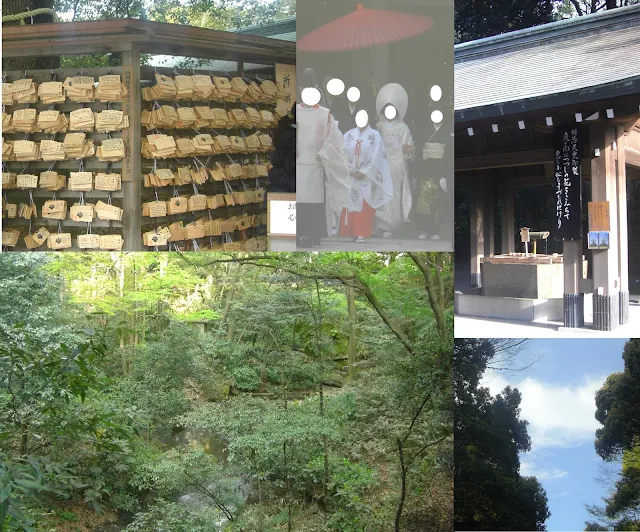

The trip was memorable and informative as it could help recollecting one of the important historical eras of Japan – Meiji Period. Emperor Meiji was open-minded to other cultures. A few lines from one of his poems says ‘By gaining the good and rejecting what is wrong, it is our desire that we’ll compare favourably with other lands abroad.’ These lines are displayed near to the Sake barrels.

The shrine closes at around 6 in the evening. Harajuku and surrounding areas were still boisterous with colorful and cheerful youngsters chirping around showing no interest to return to their nest. The shrine and the garden surrounding it stood behind us as a symbol of Emperor Meiji’s wisdom when we looked back.

My Experience with POVO After Leaving Japan - A Caution for Foreign Residents

When I was living in Japan (until May 2023), I used KDDI mobile services for many years without any issues. When I was transferred internall...