On March 22nd I wrote a simple article on living expenses for a foreigner in Tokyo. As I told in this blog and other discussion forums, cost of living in Tokyo is much higher compared to other East Asian and European nations. When I was writing that post in this blog on March, I was living alone and my family was in India. Almost three weeks after writing that post, they joined with me along with my mother.
It will be interesting to compare the cost of living in Tokyo for a bachelor and for a family, especially for foreign people. I think this will be a helpful hint for at least some of the Asians planning to come to Japan for work.
In order to tell how big the difference in expenses will be for a family in Tokyo when compared to the bachelor life, I would like to narrate the real incident. One day in May, I got a phone call from my wife saying that, one of the Japanese woman has come to our home telling something. As my wife was new to Japan, she could not understand even a single word, but could guess it is something related to the bill for gas.
As I also did not have confidence to speak in Japanese especially over phone, I requested help from one of my Japanese colleagues. My Japanese colleague after talking over phone explained to me that the Gas bill has suddenly shoot up to 13340 Japanese Yen (JPY) for the last month. Compared to the March month’s bill of 1600 JPY, that was more than 8 times high! The Japanese staff from the Tokyo Gas company was surprised and doubted for some leakages inside home. She wanted to enter the home and check! When I heard from my colleague, I thought of the promptness and alertness of Tokyo Gas company’s staff. It is really appreciable. They are not only for billing the customer, but also to educate and alert them of a sudden change in the billing amount.
My colleague explained that my family has joined with me from last month and that was the reason for sudden change. Taking the high cost of living in Tokyo with family, we could control the Gas bill for the subsequent months by putting restriction on the usage of gas heaters and water heating system.
The same thing happened to the Electricity bill during summer seasons, when we switch on the air conditioners almost throughout the day. Compared to the bachelor life, the bills for Gas, Electricity, Water and sewage, has more than tippled on average. Yahoo BB bill is same and there is no much change. The Softbank mobile bill has increased a little to reach something around 3600 JPY per month. Putting all the bills together, it comes around 30,000 JPY per month for Water and Sewage, Gas, Electricity, Mobile, Internet connection, Cable TV etc.
The drastic increase in expense is on the education. The school fee and the bus fee for children is the biggest contributor to the high cost of living for foreigners. The education is free in Japanese schools. The fee in international schools in Tokyo is too high for an average paid foreigner especially in Japanese companies. Japanese companies mostly have no separate rules for giving special allowance to support the education of children of foreign staff.
We are paying 60,000 JPY per month for the kid’s fee and 15,000 JPY for school bus. The miscellaneous expenses for the children relating to education may vary from 10,000 JPY depending on the schools. Since my kid is going to Indian International School in Tokyo (Morishita), she has to go by school bus.
To summarize, the living expense for one month on an average for a simple living family will be around 300,000 Japanese Yen. This expense does not include the House rent, tax and other deductions. Including the house rent, travelling expenses, the expense will be around 450,000 JPY per month if the whole amount of house rent is to be paid by us. Many Japanese companies pay 70 to 80% of the house rent to their employees. This is a great support for employees. Since the tax depends on the basic pay, I don’t want to make a comment here.
In short, living in Tokyo is not simple! There are very few chances in Tokyo to live simple and save a lot of money from our salary, compared to many other major cities. This makes Tokyo unique. One of the biggest cities in the world, where more than 12 million people reside at the heart of the city and more than 30 million people including the surrounding areas. The cash flow in Tokyo is high…….and still Japan has been the second strongest economy in the world!
It will be interesting to compare the cost of living in Tokyo for a bachelor and for a family, especially for foreign people. I think this will be a helpful hint for at least some of the Asians planning to come to Japan for work.
In order to tell how big the difference in expenses will be for a family in Tokyo when compared to the bachelor life, I would like to narrate the real incident. One day in May, I got a phone call from my wife saying that, one of the Japanese woman has come to our home telling something. As my wife was new to Japan, she could not understand even a single word, but could guess it is something related to the bill for gas.
As I also did not have confidence to speak in Japanese especially over phone, I requested help from one of my Japanese colleagues. My Japanese colleague after talking over phone explained to me that the Gas bill has suddenly shoot up to 13340 Japanese Yen (JPY) for the last month. Compared to the March month’s bill of 1600 JPY, that was more than 8 times high! The Japanese staff from the Tokyo Gas company was surprised and doubted for some leakages inside home. She wanted to enter the home and check! When I heard from my colleague, I thought of the promptness and alertness of Tokyo Gas company’s staff. It is really appreciable. They are not only for billing the customer, but also to educate and alert them of a sudden change in the billing amount.
My colleague explained that my family has joined with me from last month and that was the reason for sudden change. Taking the high cost of living in Tokyo with family, we could control the Gas bill for the subsequent months by putting restriction on the usage of gas heaters and water heating system.
The same thing happened to the Electricity bill during summer seasons, when we switch on the air conditioners almost throughout the day. Compared to the bachelor life, the bills for Gas, Electricity, Water and sewage, has more than tippled on average. Yahoo BB bill is same and there is no much change. The Softbank mobile bill has increased a little to reach something around 3600 JPY per month. Putting all the bills together, it comes around 30,000 JPY per month for Water and Sewage, Gas, Electricity, Mobile, Internet connection, Cable TV etc.
The drastic increase in expense is on the education. The school fee and the bus fee for children is the biggest contributor to the high cost of living for foreigners. The education is free in Japanese schools. The fee in international schools in Tokyo is too high for an average paid foreigner especially in Japanese companies. Japanese companies mostly have no separate rules for giving special allowance to support the education of children of foreign staff.
We are paying 60,000 JPY per month for the kid’s fee and 15,000 JPY for school bus. The miscellaneous expenses for the children relating to education may vary from 10,000 JPY depending on the schools. Since my kid is going to Indian International School in Tokyo (Morishita), she has to go by school bus.
To summarize, the living expense for one month on an average for a simple living family will be around 300,000 Japanese Yen. This expense does not include the House rent, tax and other deductions. Including the house rent, travelling expenses, the expense will be around 450,000 JPY per month if the whole amount of house rent is to be paid by us. Many Japanese companies pay 70 to 80% of the house rent to their employees. This is a great support for employees. Since the tax depends on the basic pay, I don’t want to make a comment here.
In short, living in Tokyo is not simple! There are very few chances in Tokyo to live simple and save a lot of money from our salary, compared to many other major cities. This makes Tokyo unique. One of the biggest cities in the world, where more than 12 million people reside at the heart of the city and more than 30 million people including the surrounding areas. The cash flow in Tokyo is high…….and still Japan has been the second strongest economy in the world!


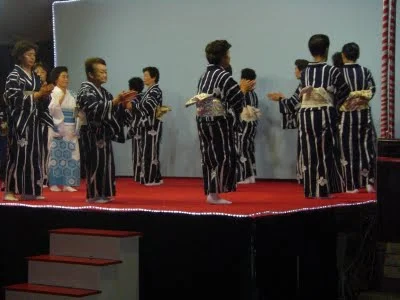
 The stage was built for the Annual ward festival. The Edogawa ward festival was organized by local leaders of Edogawa ward. Festivals are common in Japan and it helps people to gather at public places, see each other, refreshing relations and chat with each other. The daily life is busy and nobody have time to stop and chat even for a while. People might be seeing each other while travelling in trains or at shopping malls, but there are very few opportunities for them to get mixed up and come to know each other.


