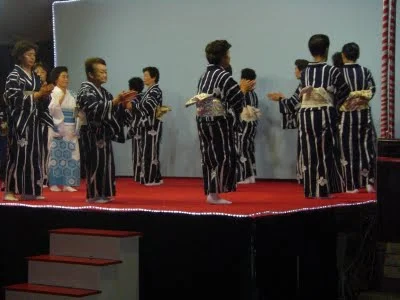
When the cute and beautiful girls flowed to the rhythm of the Hawaiian music, the stage looked magnificent. The little girls trained by a professional dancer were literally like waves in ocean. The Polynesian dance Hula is one of the most widely performed and popular dance forms in Japan.
Hula dance was performed by kids on the stage built for Edogawa ward festival organized at Komatsugawa park. Our aprtment's doors open to the Komatsugawa park and it was a nice experience watching and mingling with the local community for almost 4 hours. The programs started at around 4:0 in the evening.

The stage was built for the Annual ward festival. The Edogawa ward festival was organized by local leaders of Edogawa ward. Festivals are common in Japan and it helps people to gather at public places, see each other, refreshing relations and chat with each other. The daily life is busy and nobody have time to stop and chat even for a while. People might be seeing each other while travelling in trains or at shopping malls, but there are very few opportunities for them to get mixed up and come to know each other.
There were stalls being built on the Komatsugawa park for selling fast-food. The temporary stalls with tarpaulin were run by people from different apartments. Indians in Komatsugawa are also an influential group of minority. Yesterday there was a bolly-wood style Indian dance performed by Japanese dancers. The influence of India at Higashi Ojima area is much higher like in areas of Nishi Kasai, Ojima etc. Indians groups were also running some stalls for selling Indian food items, cloths etc.
Such festivals are good opportunities for the local Japanese people and other foreigners to know each other and are platforms for cultural exchange. Today also there are Indian classical dance performances by Indians in Higashi Ojima.

Almost all were thrilled by the hula dance performed by Japanese kids. The Hula dance form was originally developed by the Polynesians who first settled in the Hawaiian Islands. The attraction of Hula dance is the flow in the body movements of dance performers. The body becomes waves like the oscillations of ocean waves. The Hula dance style is performed with a chant or a song called a mele. The Hula dance dramatizes the stories sung in the 'mele'. Unique to the Hawaiian Islands there are many variations and styles of Hula dance.

The dance performance by school girls and other groups were also impressive. There was funny games for the elders to build the tallest structure with the empty cool-drink tin-cans. The wind was moderate and still many of the tin-can castles made were collapsed. The scene reminded me of the expected earthquake in Tokyo, which is feared to happen in any of the future years.

One of the Indian stalls was selling Samosa, Fried chicken, Rice and curry. Butter chicken curry and rice also attracted many of the Japanese people which was run another group of Indians. In between there was a stall for Indian cloths. Japanese noodles and tempura stalls also were crowded. Beer is a natural drink during such festivals and not at all considered as an alcoholic beverage.
Gatherings give enough opportunity to mingle and helps remove apprehensions whatever some people may carry in their head during daily living. Japanese people are open minded to accept other cultures. There are many stereotypic misunderstanding about for foreigners both in Japan and outside world. Many of such concerns have roots at some of the books written by western travelers long years back. An Indian view of Japan is much different from the Western view. Festivals are part of Indian society too and almost all of them are associated with temples and religion in India. I do not intend to enter into the differences in Indian view points and Western view points about Japan.
When we judge a society, first we have to be part of the society. Judgment of a person who separates himself from the society he judges and starts seeing from his cultural point may not do any good to anybody except for him to write a book.
Festivals of this kind give opportunities to know the Japanese psyche in more depth, of course by mingling with the local community, not by keeping ourselves away from them!