Showing posts with label Japanese culture. Show all posts

Monday, January 10, 2011

New Year celebrations in Japan

Before the chirping birds liven up the eastern horizon, we walked out to the chilling cold. Literally shivering in the chilling cold, yet with the single-minded resolution, we walked on Funabori-bridge that crosses the river Arakawa. The temperature was around 2 deg C. The wacky herd of seven was proceeding to the middle of Funabori-bridge to say nothing but a ‘Happy New Year’ to Arakawa River.

A New Year celebration without this ritual would have been meaningless. Arakawa River symbolizes to the whole Japan and neglecting the winter morning cold wind, we could say Happy New Year to the whole Japan. This is how we started the first day of 2011.

This year’s New Year party celebration was unique and standout with memorable events. In the past I had participated in New Year celebrations at Riyadh, Goa, Gurgaon and Chennai apart from the hometown Thrissur. This year, the celebrations started at 31st evening and continued the whole night till 2011 January 1st morning with exciting amusements. The final crazy ritual, i.e., to say loud happy New Year to Arakawa river in the morning cold was directed by Uday-san, popularly known as Neelan among friends in Japan.

New Year is celebrated in Japan in a big way unlike many other East Asian countries. The Japanese people follow Gregorian calendar and celebrate New Year's Day on January 1st the same way as Europe and America do. Though different cultures have different concepts and period for celebrating their own specific New Year day, January 1st has become an international New Year day. History says Japan was following Chinese lunar Calendar till the year 1873. I think Korea, Taiwan and Vietnam are still following Chinese calendar. Japan adopted Western style to celebrate New Year on January 1st with the acceptance of Gregorian calendar after some years of the famous Meiji Restoration.

Japanese people celebrate New Year with their own unique customs. There is a belief that if the New Year events are not done properly the rest of the year will be ill-fortune. There is a spirit for New Year also. It is called ‘Spirit of New Year’ and in Japanese 年の神 (としのかみ-toshi no kami). Spirit is Kami in Japanese language. Houses and business places are decorated with Kadomatsu (門松―かどまつ). Kadomatsu is made of bamboo and branches of pine branches. I could read more on the festivals in Japan from the notes given by Seki-sensei. Also, recently I encountered Kazumi-sensei’s blog that teaches Japanese language and customs using English and Japanese. Kazumi-sensei’s recent post has a photo of Kadomatsu. When we went to Oshiage to see the Tokyo sky tree yesterday, I could take photo of Kadomatsu that was displayed in front of a Japanese restaurant.


I used to receive New Year greeting cards from my colleagues for the past years. This is a custom in Japan to send post cards to friends and relatives similar to western culture. In India too people send greeting cards to friends and relatives. With the growth of internet, e-cards are popular recently. New Year day post card is known as nengajoo年賀状 (ねんがじょう).

The New Year cards were there in the post box on first day of January itself! New Year cards arrive on first day of the year and thereby convey the spirit and warmth of the sender to the receiver. This year I received a New Year card from Mana-Suzuki Sensei, who is my Japanese sensei on Sundays. Sensei gave two gift cards too. It is also a custom in Japan to return or reciprocate equally for any kind of favors one received from another person. I can use those gift cards from the nearby convenient store (Konbini – コンビニ) to buy things.


Though Japanese adopted Gregorian calendar and celebrate New Year on January 1st similar to the western cultures, the customs and rituals are purely Japanese. This is point Japan differs from other countries. My observation is that Japan adopts things from other countries and soon converts them to a unique Japanese style.

Once something is accepted to Japanese style, it is very hard to identify it as foreign again, similar to the process happened to the word ‘convenient store’. The word ‘Convenient store’ is adopted to Japanese language as Konbini and foreigners without any introduction to Japanese language can never guess any of the similar English word like Konbini. New year celebration and customs in Japan too are best examples of this typical Japanese adoption process. Such an indigenous conversion happens in Japan and this is one of the distinct characteristics of Japanese culture.

Saturday, March 06, 2010

Two years of life in Japan

It is more than two years in Japan!. Still the moments of departure from Cochin airport remain fresh in memory. It was not so long before that I left India to Japan. The period spent in Japan is around 5% of my life till now, but the diversities and excitements of experiences have been vast and have substantial effect in life.

I did meet a young man from China at Morishita last week, who was in Tokyo for a short business trip. While sharing general things like the socio-political and cultural differences between China and India, he got curious in my stay in Japan and attitude towards life in Japan. My answer was short: Life in Japan is calm and peaceful.

When I say the life in Japan is calm and peaceful, it just reflects the general attitude of a majority of foreigners living in Japan. This ‘calm and peaceful life in Japan’ image should be embroiled with the private or professional life. The experience of working in Japan, that also for a Japanese company is totally different from that of working for a company from any other countries. The calm and peaceful atmosphere prevails in the general life affairs in Japan.

Almost all basic necessities of are easily available and easily accessible in Japan. One of such thing that will strike in the mind of a foreigner in Japan is the ‘convenient stores’. They are really convenient and make the life simpler and easier. We don’t need to wait behind long queues to pay the utilities bill when it can be paid in less than one minute in a nearby convenient store. The food for breakfast, lunch and dinner, snacks and many kinds of eatables and juices are available all the time, all the days in a week.

Convenient stores are called Konbini’ in Japanese language. It is written in Katakana as コンビニ [Ko-n-bi-ni] and this is one of the Katakana words I liked to use frequently while talking with friends. As sensei compares jokingly, Konbini is the friend and Konbini is the spouse of many of the workaholic and lazy people. Convenient stores are now a synonym with a life partner for many of the bachelors in Japan.

Another striking point during the last two years is the obedience to the law and order in Japan. This can be translated into the discipline in public places. The life in Japan is like a life in a company called Japan Incorporated. Whatever be the roots to this existing discipline and obedience to the law, it is a great plus point for the Japanese society, which they might have cultivated with consistent efforts over many years. Such kind of public discipline can not be implemented with the aid of external forces within a short period. It is the inborn nature of Japanese people to obey the rules and regulations. This is one of the concerns when Japanese companies bring foreign people from different cultures to Japan that the new comer to Japan may feel uneasiness to easily absorb into Japanese culture. It takes long time to get adjusted with the new social structure and in many cases the foreigners does not get involve in the mainstream. They resemble the floating element that may fly away after some time. There are cases where foreigners who can manage communication in Japanese language get involve in Japanese social and cultural events along with local Japanese people. If the language barrier is removed many of the routine concerns of foreigners will be solved.

The life in a company called Japan, ruled by some rules and regulations, is convenient when the new comer to Japan starts learning what is good and what is bad in Japan. One of the great information sources maintained by Japan Police is really helpful to foreigners to understand the rules in Japan. Rules Regarding life in Japan is a must read document which is written in English.

There are many websites dealing with the life in Japan especially made for foreigners in English language. Japan is one of the leading countries in terms of broadband internet users, second after South Korea, but tops in terms of fiber to the home broadband internet connectivity. The websites and online information sources dealing with the life in Japan for foreigners are helpful to those who wish to come to Japan. One of such useful sites, that is worth to add to the favorites in your browser is Your Complete Guide To Life In Japan!

Looking back to the two years life in Japan, by knowing only survival Japanese language to communicate, I feel what is more required to live in a different culture is the ‘empathy’, which will drive us to fusion.

Sunday, November 08, 2009

Respecting the nature is a traditional way of Japanese culture!

Enjoy the nature and tradition just 50 minutes from Shinjuku station!

This is the advertisement caption on which I get something to stare while riding on Toei Shinjuku trains to and from Higashi Ojima on weekdays. Most often this advertisement shown on the Toei Shinjuku line trains or Keio line trains that goes to Keio-tama center is the one that has caption in English. Indeed, advertized to attract foreigners, Mount Takao is a place to visit especially during the season of color change of leaves on November second week.

By repeatedly seeing the advertisement inside the trains, we decided to make a trip to Mount Takao today. We are just back from Mount Takao, which is just one and half an hour away from our house at Higashi Ojima.

The ideal visiting season is November when the trees change the colors. Mount Takao looks gorgeous with trees bearing colored leaves in a varying mix of red, yellow, green, pink, orange, dark brown and grey. The winter is near and the trees will prepare themselves to shed the leaves. During autumn season, maple leaves change color which is known as momiji in Japanese. もみじ momiji is romantic season in Japan and we could see many young couples making their trip to the top of mount Takao.


Mount Takao is 599 meters tall in the city of HachiOji. HachiOji is in Tokyo prefecture and for me HachiOji is particularly important as one of the initial visitors to this blog Mr. Hashimoto was from this place. Mount Takao is a popular hiking spot for Tokyo people.


To reach Takao-san, take a keio line train that goes to Kitano and then change to Keio Takao line to reach Takaosanguchi. Alternatively, from Shinjuku, we will get express train to Takaosanguchi. Pasmo or suica card holders do not need to buy separate tickets to reach Takaosanguchi.


From the basement of Mount Takao known as Takaosanguchi, where the Keio trains stops, we need to walk around 5 minutes to reach the cable car station. We had two option to reach at the top of Mount Takao. One is by using Cable car and another one is by lift chair. Lift chair will be an open air atmosphere and as we were with small kids and strollers did not opt to use. Cable car was pulled by giant high strength ropes that was operated from the station at the top of the mount Takao. The cable car have two cars and the travelers are well controlled by the staff at the entrance. The round trip by cable car costs 900 Japanese yen for adults and for children below 6 years old it is free.


It took around 3 and half minutes to reach the station at the top of Mount Takao. We could see the Tokyo city far away with skyscrapers looking like match boxes piled one over one. The observatory hall built on the mountain has telescopes that operate by inserting 100 Yen to view the far away places.

Walking further through the forest, enjoying the nature and tradition as the advertisement says, we could see many sculptures on the way to Yakuoin Buddhist temple. The temple built with the traditional Buddhist style have influence of Chinese architecture.


Though not so far away from busy Tokyo city, Mount Takao is rich in wildlife with more than 1200 species of plants, bushes and diverse species of insects, birds and animals.

The temples in Japan as per my experience goes is a mix of Buddhist and Shinto cultures and almost all of them I have visited have Buddha and other Shinto Gods. The Gods co-exist in good harmony in all the temples. We could see many Gods in the temple and too many sculptures of Buddha everywhere on the way to the temple. We learned that visitors to Yakuoin temple pray to mountain Gods (tengu) for their better future and good fortune.


One of the photo shown in the advertisement inside the trains is of such a God having long nose with an angry face. We could see many statues of Gods with long nose and another with a crow beak in the Yakuoin temple premise.


It was 5 in the evening, but was dark when we got inside the cable car to come down to Takaosanguchi. The journey was too memorable and all of us enjoyed, with plans of revisiting as we could not cover all of the attractions on the top of Mount Takao. Probably we need one more day to plan the journey properly.


Mount Takao, Takaosan as Japanese people say with respect, is one of the best examples of traditional Japanese culture of respecting nature and living things equally. Behind all those sculptures, the shapes we saw on the way to Yakuoin temple, the customs being followed in the temple, we could realize that it is a tradition in Japan to respect the nature!

Tuesday, September 22, 2009

Vibrant Harajuku and Meiji Jingu Shinto shrine in Tokyo

It was a huge crowd outside Harajuku station when we came out. The crowd was moving slowly but gently. The purpose of the visit was uncertain when we started from Higashi Ojima. I did a google search for ‘Places to see in Tokyo’. Some of the search results guided me to see Fuji mountain, Kamakura, Tokyo Tower, Shinjuku, Odaiba, Ueno Park and zoo, Ginza, Yokohama China town etc.

Even by repeating the searches in Yahoo and other search engines I got the same places in the search results. I was eager to get something different from general search engine recommendations. The same thing happened for the first few pages of search resuslts, when I changed the search keywords to ‘Must see places in Tokyo’, but this time I got a place ‘Harajuku’ in the list recommended by an American tourist who had visited this place on his trip to Tokyo.

That was the motivation to visit Harajuku today. We could see live animation characters outside the station, lesbians and some groups of gays. I am not sure whether this is the normal view of Harajuku station. There were groups of young Japanese girls and boys sitting on the nearby stone benches which seemed to me as a mere casual meeting.

I have been taking my brother to different places in Tokyo now a days on his short trip to Tokyo. We walked to the direction of the crowd. It helps many times in life when we move with the trend. There will be always something towards which the crowd goes. The psychology of the mass or crowd is also motivated by the determination of those who move on the front. When we turned left, right after the Harajuku Yamanote line station, we could see a forest, virtually more beautiful than the real forest and a historical style entrance.


Before entering, we could collect leaflets that described about the place and its importance. To our surprise, it was ‘Meiji Jingu’ which is a Shinto shrine. Shinto is Japan’s religion, which has no founder, no holy book and no concepts of traditional religions. Shinto is a way of Japanese living with high values respecting the nature and living things. The Shinto shrine which we visited accidently is dedicated to the souls of Japanese emperor ‘Meiji’ and his consort empress ‘Shoken’. It was interesting to know that their tomb is in Kyoto.

This forest was made by Japanese people by donating trees from different parts of Japan and from all over the world. It is now the history that there are 100,000 tress total in the forest and it was established on November 1920. The artificial forest in the middle of concrete forest looked more than the natural forest.

We could see a collection of rice wine barrels on the side of the path towards the shrine. The visitors were eager to take snaps of the traditional Japanese customs and architectures around the main shrine. In Shinto religion, divinity or diving spirit is known as ‘Kami’. Unlike Christian religion which talks about one spirit, Shinto religions has no limit in the number of divine spirits or Kami. There are unlimited number of kami. Kami can be observed in Nature, mythology or in human beings. It is said that from times unknown Japanese people have felt awe and gratitude towards such Kami (divine spirit) and have built shrines to such Kami.

This kind of belief is similar to the believes in Hindu religion, the most widely practiced religion in India. In fact in India, these divine spirits became Gods over a period of time and they also got one or several shrines according to their popularity.


We could see Japanese traditional style marriage being held inside the shrine premise. Many visitors were taking photographs of the ceremonies. Meiji Jingu Gardens or Gyoen was the part of Meiji Jingu Shrine that has been existing long before building the Meiji Jingu. Emperor Meiji designed this iris garden, small paths and fishing spot for Empress Shoken.


“Although we may feel Overworked and burdened,
Our human hearts should go on remaining filled with an open calmness” is the Waka poetry written by Empress Shoken. The wisdom of Emperor Meiji and Empress Shoken were handed over to the generations next through these Waka poems. Visitors can draw a poem from 30 selected poems from the ‘Omikuji’ box, which exists in front of the main shrine.

Now not exaggerated to say, our visit to Harajuku was really worth. It took us to a different world in the middle of modern Tokyo. I can strongly recommend now to visit Meiji Jingu and Harajuku for those who plan a short visit to Tokyo along with their visit to Shinjuku. It is just two stations away from Shinjuku station on the JR Yamnote line. Harjuku is also a place for fashion and we can see many live animated models walking on the road! Have a nice trip to Harajuku!

Sunday, August 02, 2009

Festivals are essential drivers for social life

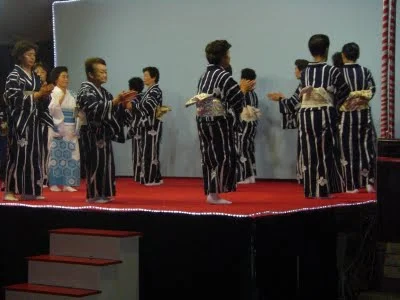
The second day of Edogawa ward festival at Komatsugawa park had some new and exciting shows. The dancers were more professional and their movements were eye catching. There were professional drummers brought to perform at Komatsugawa stage. They took the audience to a highest level of enjoyment.

The social gathering found a new phase when the local Indian community got mixed with the Japanese people in stage performances also. Indian girls performed classical dances and the performance of Bharatanatyam, a form of classical South Indian dance by an Indian girl got wide appreciation from Japanese community. Interestingly the dance performer’s teacher is a Japanese national.

Japanese students also have shown their dance skills for the second day of the festival. The food stalls were crowded. Kimono dress stall also attracted many people.

During one of my trip back to India, I could meet Ms Nakamura from Tokyo, who teachers Indian dance to Indian and Japanese students. She is a well known dance performer in Kummi dance, which is a dance form being performed in Tamilnadu, one of the south Indian states. It was a new experience to hear from a Japanese about classical dances of India.

At the end of the stage performances, the Japanese classical dance was performed. The old woman performer showed her skills at the stage and dancers came down to the ground to join with the public. The public also joined with the dancers and they made a circle, moving slowly with a dance steps around a tree. It was a perfect example of cultural fusion point. People from different nationalities, most of them from India, joined in the traditional Japanese dance.

It was 9 O’ clock in the night and still the music was in the air compelling people to dance with the steps shown by the elder performer at the stage. People were not tired even after making several round around the tree with dancing steps. Departing seemed painful for many people.

The next day, while going to office I could see some people still sitting around the stage and park as if they did not like to go back. This is the gloomy part of any festival. The festival and celebrations will be over, but still people carry the memories with them.

The good moments they shared in the social gathering and celebration linger in the mind. That is one of the purposes of festivals. The sweet memories tempt people to organize and join for festival in the coming years too. This is what we also do, waiting for the next year’s festival. Such small hopes are the bigger motivations for life – essential drivers of social life.

Sunday, May 31, 2009

Thoughts on Japan, society and Japanese people

Walking down the street, we had an interesting discussion with us. How came the Japanese so different from other East Asians? Discussed in many social forums may be thousands of times by veterans, these topics are still alive, but I particularly had nothing new to add to my opinion. Choi bun-san had something new to tell me.

Being from Korea, he knows well that the physical difference between most of the East Asians and Japanese is almost zero, especially with the northern Chinese and Koreans. The looks are similar, but when he says the attitude and behavior is different I had to agree. How can I, better than him be able to differentiate similar looking people. The race is same, the physical appearances are same, but there are still elements that separate Japanese people from others.

The culture, the language, the behavior, the response towards events etc are different. This does not mean that Japanese people are free from all kinds of bad manners or they are extra ordinarily obedient or disciplined. When I say from my own experience that Japan is clean, people are disciplined, law obedient, well-mannered, free from social crimes, I never mean that Japanese society is one hundred percent free from all kinds of dirt, indiscipline, law breakings, ill-manners, anti-social activities etc.

There may be bad people in Japan as it is with any society. There are dirty things, there are unclean areas, there are violations of law and rules, there are aggression in the public places, there are murders, rape, child abuse, there are drunken people shouting in public places, hundreds of cases of anti-social activities reported from Japan and thus goes the list of all bad things in society just the same way like in any other society. Japanese people are not extra-ordinary people in the sense that they are just like the same kind of human race as is with any other human population. Japanese people are extra-ordinary in their attitude to eliminate or free themselves from many of the evils in our societies. That attitude makes the difference. That attitude of Japanese people reflects in their whole education system and social fabric.

It is just that! But this is the great thing with any human population. The attitude and nature of majority of Japanese people are warm, welcome, pleasant and optimistic towards others and their own life. Is it not the same with other east Asians? Are they not warm and pleasant? Of course, Yes. They are also good and their societies are also warm. Just the percent of that elevated class of human beings are more in Japan. This makes the difference and projects Japan in a well frame to the rest of the world.

Choi bun-san had his own versions to justify his observations. I have very few opportunities to know more deep about the real Japanese psyche.

Who is bad and who is right? How can we judge people without any prejudice? When we make standards for measuring or observing or judging other characters, always those standards will be affected by our own views. Then those standards cease to be neutral. In fact, there may not be any neutral standards by which we can measure human beings and their behavior. We are not better judges of anybody.

It is heavily raining outside as I started recollecting the conversations with Choi bun-san. Today’s News paper head lines carry the news of war planes reached from America to Japan.

Japanese society has been peaceful and quiet for many years. The life here is also peaceful and calm. Japanese society is well taught to respect each other and respect strangers. The Bushido culture teaches to respect the enemy too. Historical evidences shows the fighting communities within Japan respected each other in war.

Napoleon Bonaparte, after capturing Russia, decided to return back without touching China. The reason he told to his military was that it is a sleeping monster. Sleeping does not mean weakness. Japan is not weak only because Japanese people love peace.

Sunday, May 03, 2009

Japanese discipline – obedience to the law and order in Japan

Discipline is part of Japanese culture. It is neatly interwoven to the psyche of each Japanese citizen. It won’t be much exaggerating if I say Japanese people are obsessed with discipline.

There was an interview for foreign staff at the work place last year and I was being asked by the interviewer ‘what is your impression about Japan and its people?’

Well, that was an interesting question to answer. Almost naturally, without thinking I answered ‘Discipline of Japanese people’. The interview board was interested to know more about my impression on the discipline of Japanese society. One of the members asked me the spelling of the word discipline. He wanted to check the exact meaning of discipline in his language translator device. He asked me and I spelled D-I-S-C-I-P-L-I-N-E.

Probably ‘discipline’ is a bit difficult word for many Japanese people to pronounce. Most of them make mistake in writing discipline and they may write it as ‘disipirin’. The L and R confusion of Japanese people is very well known to them as well as to the foreigners in Japan. Japanese language has only one sound for R and L, the sound of which is in between RA and LA. Then, to many Japanese people, the ‘Light’ will be the ‘Right’ and ‘Law obedient’ will be the ‘Raw obedient’. I remember reading a site ‘Old brains learn New tricks’ in which the difficulty of Japanese military to distinguish L and R is expressed though an example when the GIs in the Pacific theater chose passwords overrun with R's , words like "rabble-rouser" or "rubbernecker." The reason was the Japanese people have a 'ell of a time with R, which they often pronounce as "ell."

He got the meaning of discipline in Japanese and we discussed the discipline and culture of Japanese society. The culture of a well disciplined Japanese society is known throughout the world. In school, the teachers used to tell us about the Japanese discipline and the benefits the Japanese society derived out of their discipline. Getting inside the train, getting out of the train, walking to the escalator (Eskureta in Japanese is modified form of escalator) are some of the occasions we encounter the discipline of Japanese people. I expressed my good feelings on the discipline of Japanese society to the interviewers.

By definition, the discipline is the training and control of oneself and one's conduct, usually for personal improvement. Since long, Japanese society had implemented discipline to its social structure as one of its essential constituent element. The Japanese Kanji character for discipline is 訓練. The Japanese samurai culture was based on discipline as the word indicates. Discipline refers to systematic instruction given to a disciple. In one sense the Bushido culture was programmed or instructed social system. Of course those instructions have been proved good to the present day Japanese society.

The obedience of Japanese people has its origin in the disciplined behavior which was instructed from childhood. Small kids will be trained by parents for good public behavior. The obedience to the law, the obedience to the system, the good manners in public behavior etc will be continued and reinforced through teaching in schools.

The culture of Bushido stressed on the importance of discipline. Discipline in English means ‘to instruct a person to follow particular rule, or ‘to adhere to a certain "order." This adherence to the order and the obedience to the order from higher ranking officers made the Japanese military one of the significant forces during World War II. I don’t want to enter into a controversy whether Japanese military was right or wrong during Second World War.

Coming to daily life experience in Japan, I have been observing the public discipline of Japanese people especially in railway stations. The pin-drop silence in railway stations in Tokyo is a live example of the discipline and good manners of Japanese people. The discipline may not be always corresponds to the education only. It depends on many factors one of which may be the level of education. Education does not mean simply holding a university degree, but with a more meaningful explanation, manifestation of the self as 'Swami Vivekananda' emphasized. When the education arms an individual with a powerful social tool ‘Empathy’, the entire society and nation become its beneficiary. Empathy is what many of us lack.

The discipline of Japanese children is incredible! Children too are learned to obey public behavior and rules. Learned from elders, they are not behind any of the adults and on many occasions better than the adults in observing obedience and discipline.

‘Discipline’ is one of the best characteristics of Japanese society, which I admire and would like to proclaim to the rest of the world.

My Experience with POVO After Leaving Japan - A Caution for Foreign Residents

When I was living in Japan (until May 2023), I used KDDI mobile services for many years without any issues. When I was transferred internall...